Loading. Please wait...

AppReply MAX combines live URL knowledge with customer-scoped approved-reply memory, so each draft can use the product information and response history already trusted by your team.
For mobile app and game teams, review response quality usually breaks at the exact moment volume goes up. That's after a release, a pricing change, a live ops event, or a support spike, when replies need to be most accurate and your team has the least time to write them.
AppReply MAX is our answer to that moment. It combines live URL-based knowledge with customer-scoped approved-reply memory. The goal is simple: give each draft the product information and response history your team already trusts, even as volume grows.
Two new capabilities sit at the core of the release.
Knowledge bases used to mean uploading files every time you shipped. That worked when your docs changed once a quarter. It does not work when your help center, changelog, pricing page, and FAQ move every week.
With AppReply MAX, you paste a URL. AppReply crawls the page, indexes it, and keeps it in sync on a cadence you choose.
 Add URL source modal with re-crawl frequency and application scope
Live URL sources live alongside any documents you still want to upload manually, so teams can move existing knowledge over at their own pace.
 Knowledge base view showing a live URL source next to uploaded documents
The practical effect: one less release-day chore, and replies that stay aligned with the latest version of your help center, changelog, pricing, and FAQ pages. Available now on the Pro plan.
AppReply has always been good at finding relevant past responses. The harder problem is retrieving the approved replies, edits, product facts, and tone examples that actually fit the review in front of you.
That is what Agentic Memory is built for.
Response method picker with three memory tiers: none, basic, and agentic
In an internal evaluation using LongMemEval, a public long-memory benchmark, the memory layer retrieved the relevant information correctly in 95%+ of cases. That is a memory-retrieval result, not a blanket accuracy claim for published replies. For app and game teams, the product behavior is simpler: the draft can pull from relevant material already approved inside the same account.
When Agentic Memory is enabled on your account:
 Memory graph showing connected facts about an app, including recurring issues and resolutions
Under the hood, MAX organizes account-specific issues, fixes, and language so it can retrieve the relevant pieces for a new draft.
As your approved-reply history grows, MAX has more account-specific material to retrieve. Your team still chooses which rules publish automatically and which replies require approval.
One useful side effect: your release notes are now stored in Agentic Memory automatically. The response agent stays current with shipped changes without anyone having to paste notes into a knowledge base.
Agentic Memory is configured per account while we roll it out. If you'd like it enabled for your app portfolio, message us from the Chat panel in your dashboard and we'll set it up.
Live URL sources are available to all Pro accounts today. You can add your first source from Knowledge base in the sidebar.
As we roll out the new retrieval and memory layers, monthly reply caps on a few plans will come down slightly to protect reply quality. They remain among the most generous in the category: 1,500 on Standard, and 5,000 on Pro with customer-scoped memory enabled.
If your team is running close to the new limits, reach out and we'll find the right fit.
Bring monitoring, full Analytics, MAX, and Reply Quality into one app review workflow.
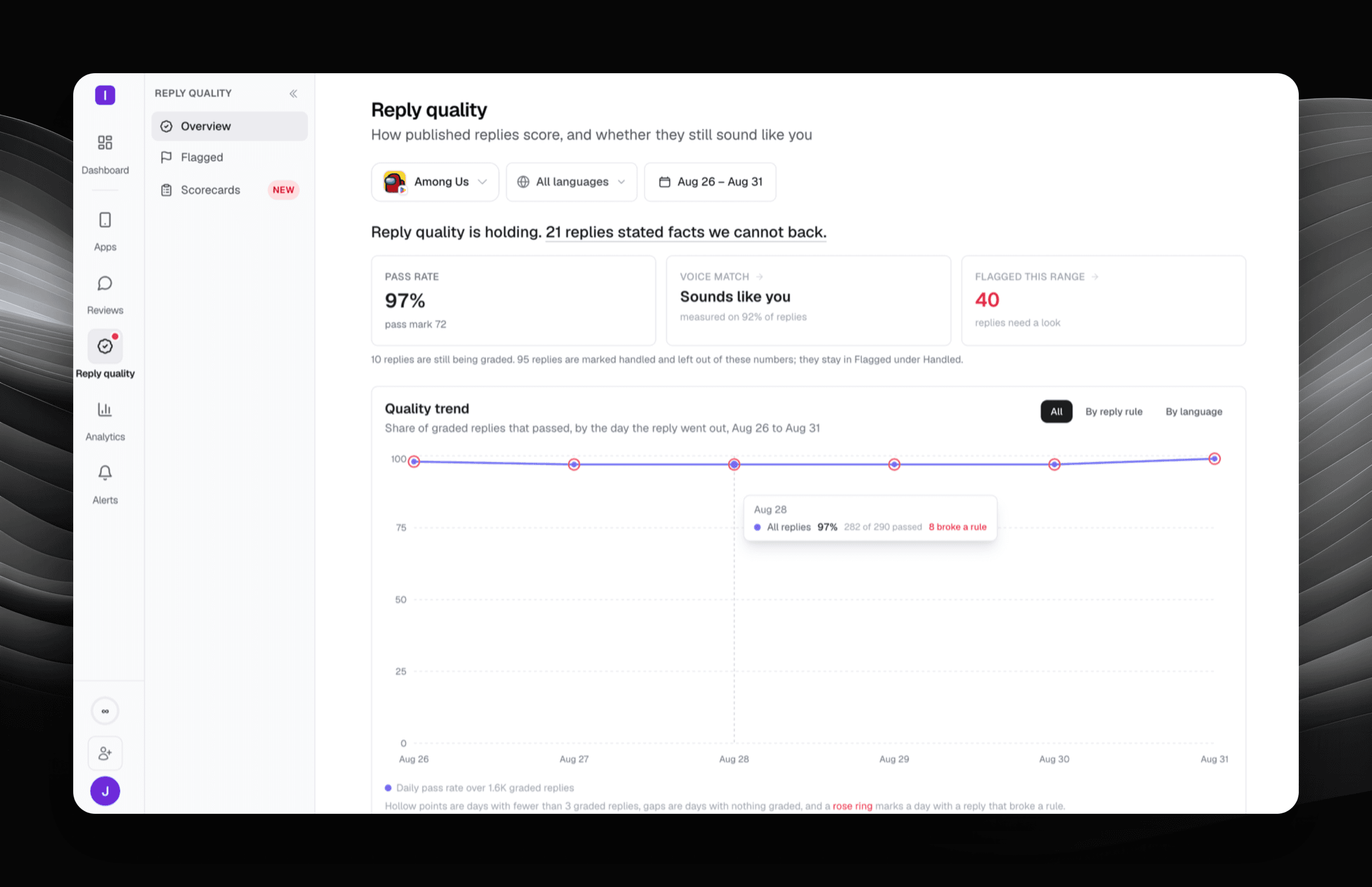
Reply Quality grades every published app store reply against a scorecard you write, and quotes the exact words that broke a rule.


Apply your existing auto-reply rules to featured reviews with one toggle on Google Play and the App Store, and get faster, higher-quality AI replies after our upgrade to GPT-5.6.