Loading. Please wait...
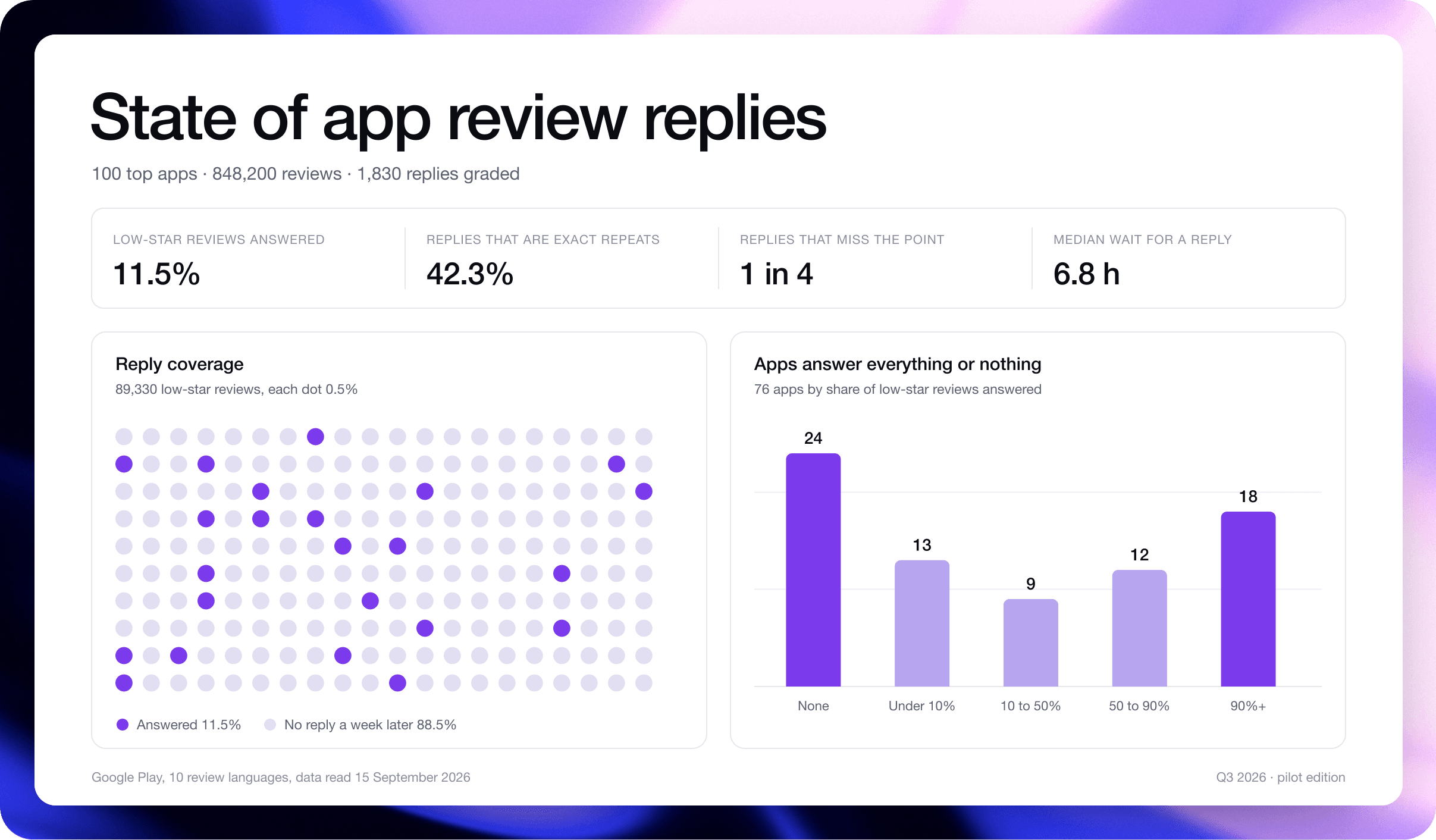
State of app review replies 2026. The stores now read how you reply: Google's app quality audit checks whether replies are templated or personalised. So we read 848,200 reviews across 100 top apps and graded 1,830 developer replies. 8 in 9 low-star reviews got no reply, 42% of replies were word-for-word repeats, and 1 in 4 replies to a complaint missed the point. Plus how games and other apps differ, what good replies do, and a checklist for your own.
State of app review replies · Q3 2026 edition (pilot) · Data read 15 September 2026 · Next edition: Q4 2026
Someone opens your app, it crashes, and they take a minute to tell you. On Google Play, about 8 times in 9, nobody answers. The review stays there, under your app, for everyone who is deciding whether to install it.
For years that was a customer service problem. It is becoming a store problem. Google Play and the App Store now summarise what reviews say, and the developer replies sit inside that text. And in September, Den Markov published how Google's app quality audit scores Play Store apps. One of its scores reads the reviews. What it looks at, in his words:
Not the rating itself, but the content of the reviews: which complaint patterns repeat, what people praise, how the developer replies.
And what it weighs:
Reply rate and the quality of replies: templated or personalised.
His case study is an app with a 100% reply rate, all templates. It scored Medium, 5 out of 10, with a rating of 3.54 against a category average of 3.9. The fix he gives: stop answering one-star reviews with a template, because a personal reply about the specific bug gets the rating revised noticeably more often.
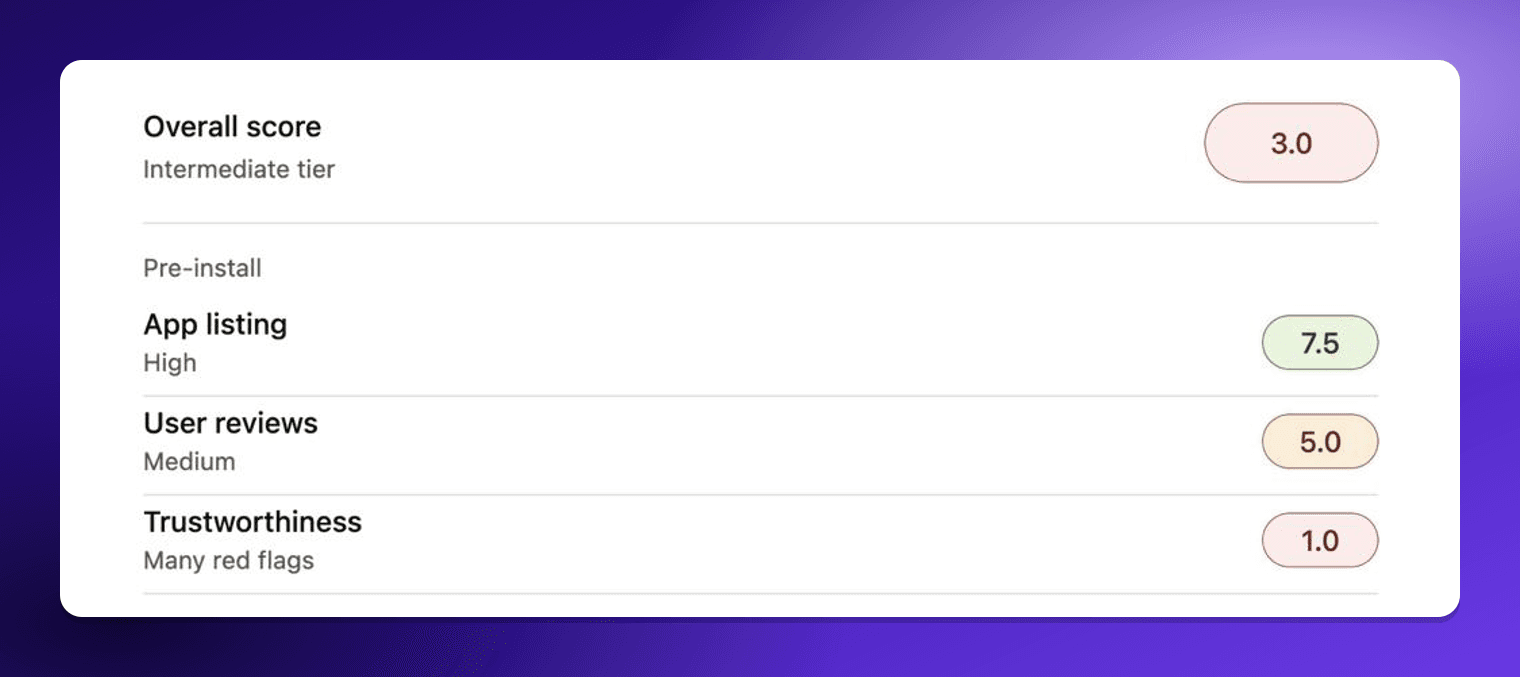 The case study app's audit scores: a 100% reply rate with templates still left user reviews at Medium. Screenshot from Den Markov's breakdown.
Quotes translated from Russian. We explain what this means for your app in our guide to app reputation management.
So we set out to measure the thing the stores are starting to read. We read 848,200 reviews across 100 of the biggest apps on Google Play and graded 1,830 of the replies developers wrote back. Two questions: how many reviews get an answer, and is the answer any good?
Mostly, no on both counts. Most apps are not replying, and many that do are pasting the same few lines. Reply rate counts replies. This study also reads them.
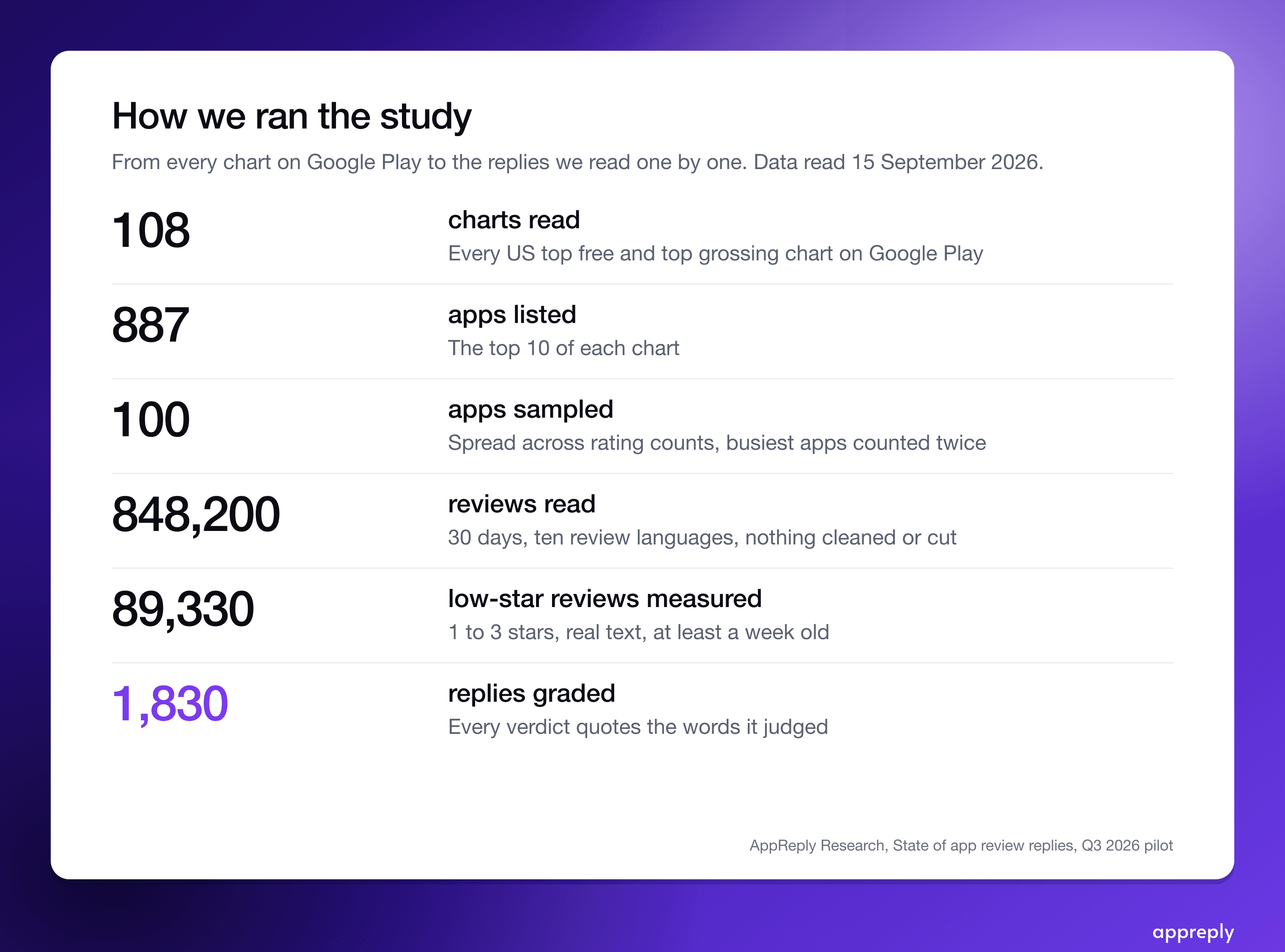 Each step narrows the data, and every number in this report traces back to one of these rows.
This edition is a pilot: 100 apps from the top of the US charts, read once, with a grader not yet checked against human raters. Treat it as a careful first look. The full methodology and its limits are at the end.
The number that surprised me most was not the 11.5%. It was how often a reply existed and still said nothing. So we made one rule for the grader: every verdict has to quote the reply it judged. 'This reply is generic' is an opinion. A highlighted sentence is evidence. That rule made the study slower to build, and it is why we trust these numbers enough to publish them.
Indrit Kello, software engineer at AppReply, who built the study
We counted one to three star reviews with real text, at least a week old, so every developer had time to answer. Of 89,330, 11.5% had a reply.
The star rating barely changed it. A one-star review was hardly more likely to get an answer than a three-star one. Praise got the fewest replies of all.
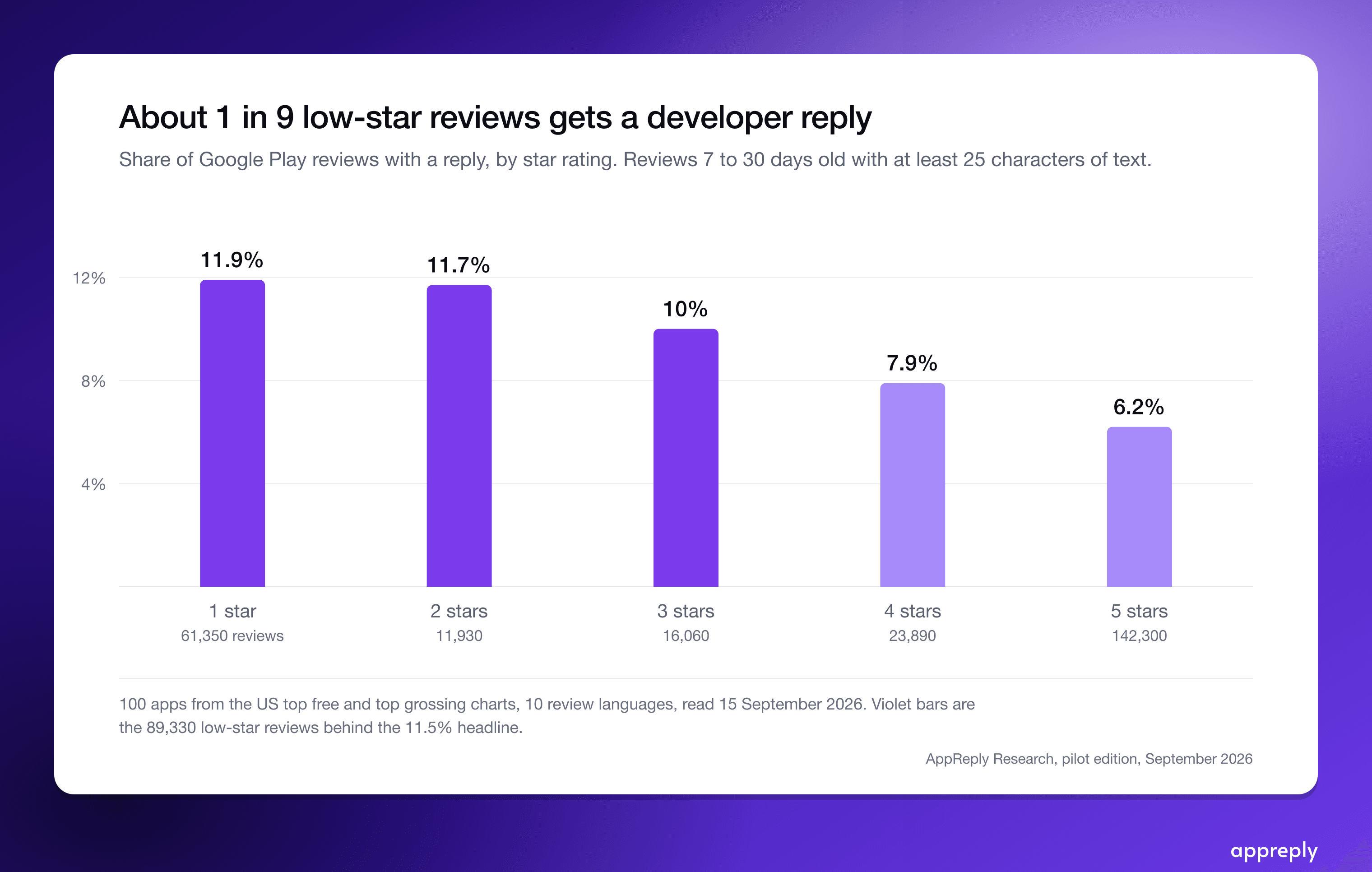 Coverage is low at every star rating, not only for the angriest reviews.
Taking more time to explain helped a little. Reviews of 150 characters or more were answered 13.7% of the time, shorter ones 10.4%.
The average hides the real shape. App by app, reply rates pile up at both ends.
Of 76 apps with at least 30 low-star reviews, 24 answered none of them. 18 answered 90% or more. Only 9 sat anywhere between 10% and 50%.
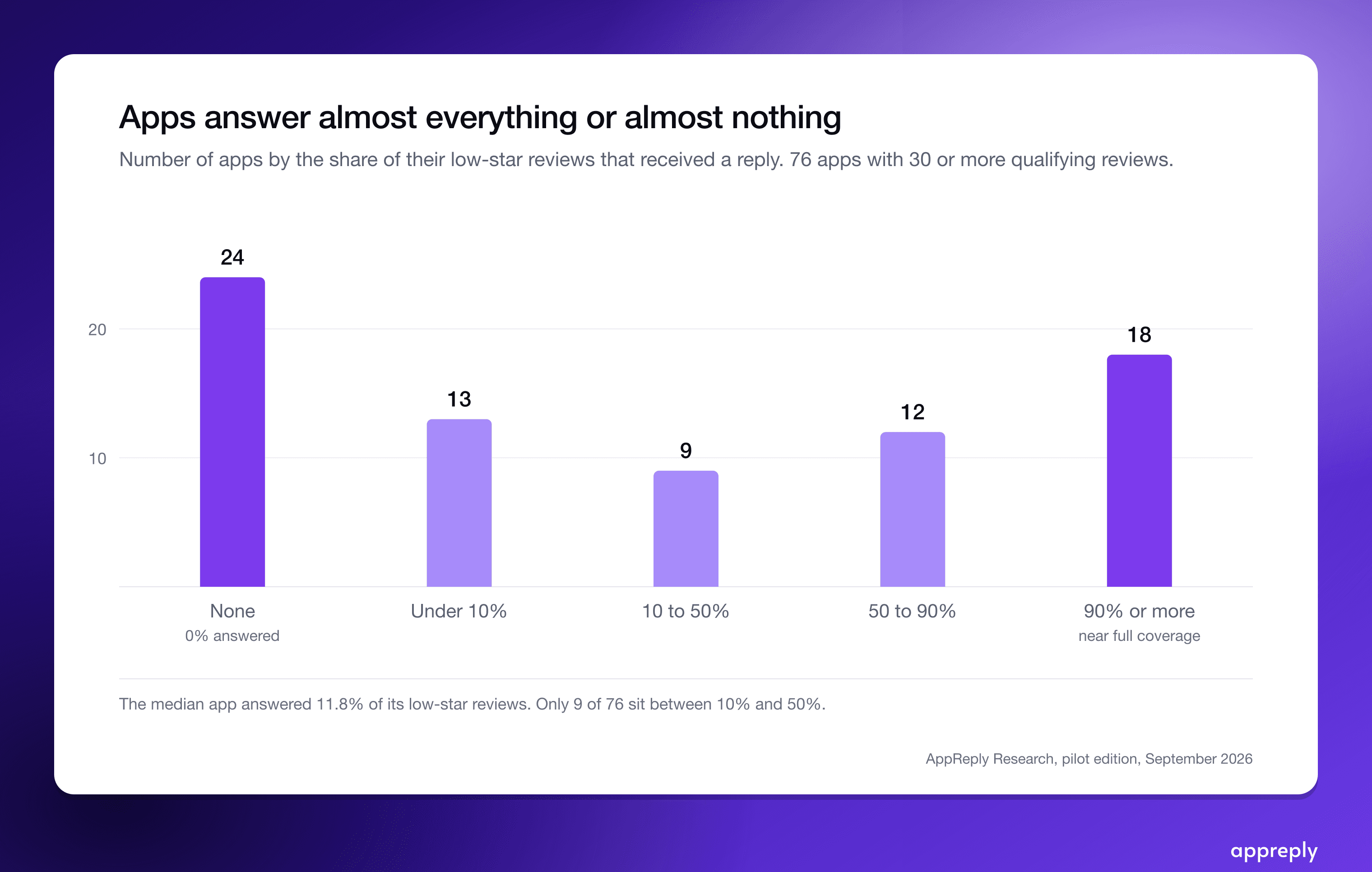 Most apps sit at one end or the other.
So reply rate is less a dial than a decision. A team either set up a way to answer reviews, or it did not.
The 14 apps with 500 million installs or more got three quarters of all the low-star reviews in the study. They answered 3.2% of them. The median app in that group answered 0.9%.
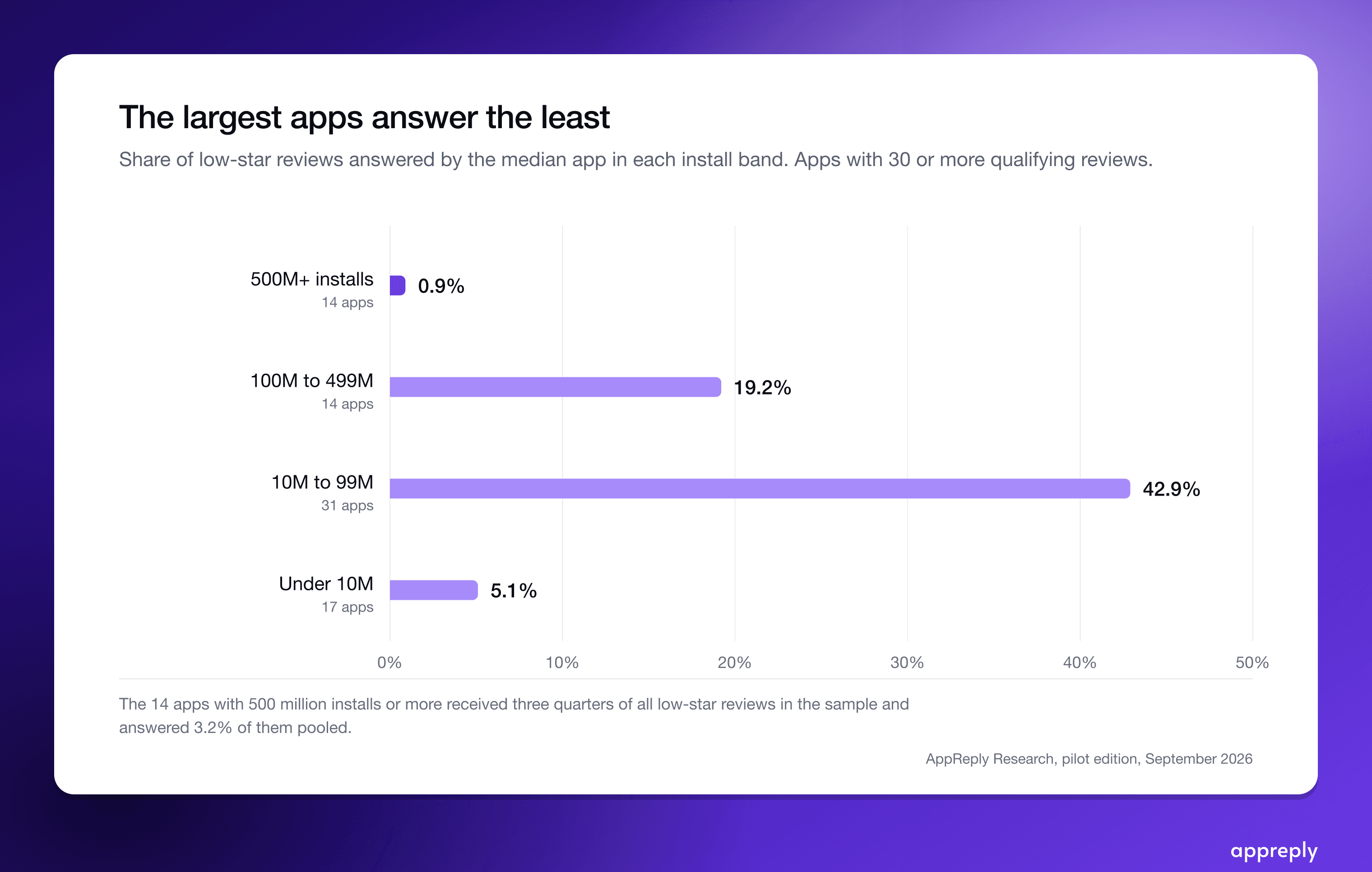 Mid-sized apps answer most. The giants answer almost nothing.
The apps with the most people reading their reviews say the least back. The median app with 10 to 99 million installs answered 42.9%.
This was the biggest gap in the study. The median game answered 42.6% of its low-star reviews. The median non-game app answered 2.1%, and 16 of those 42 apps answered none at all.
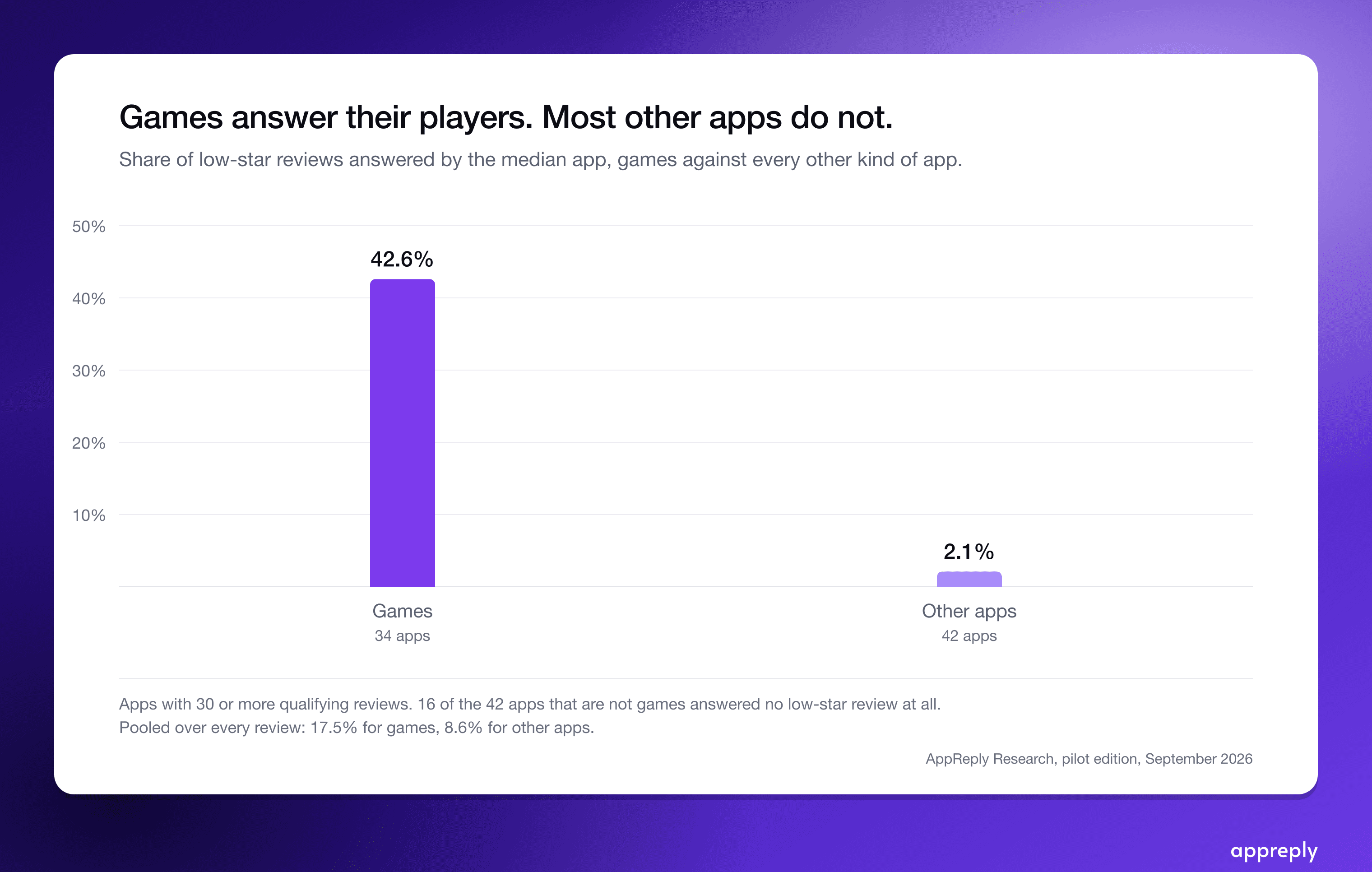 The median game answers twenty times the share of the median app.
Players are a community, reviews arrive in waves after every patch, and a game lives or dies on its rating. Game teams act like it. More on how they keep up with that volume on our games page.
Split every number by games and other apps, and the two groups turn out to reply in opposite ways. Games answer far more reviews, but take longer: a median wait of 25.6 hours, against 2.1 hours for other apps. And the median game repeats itself less. Once either group answers, it misses the point about as often.
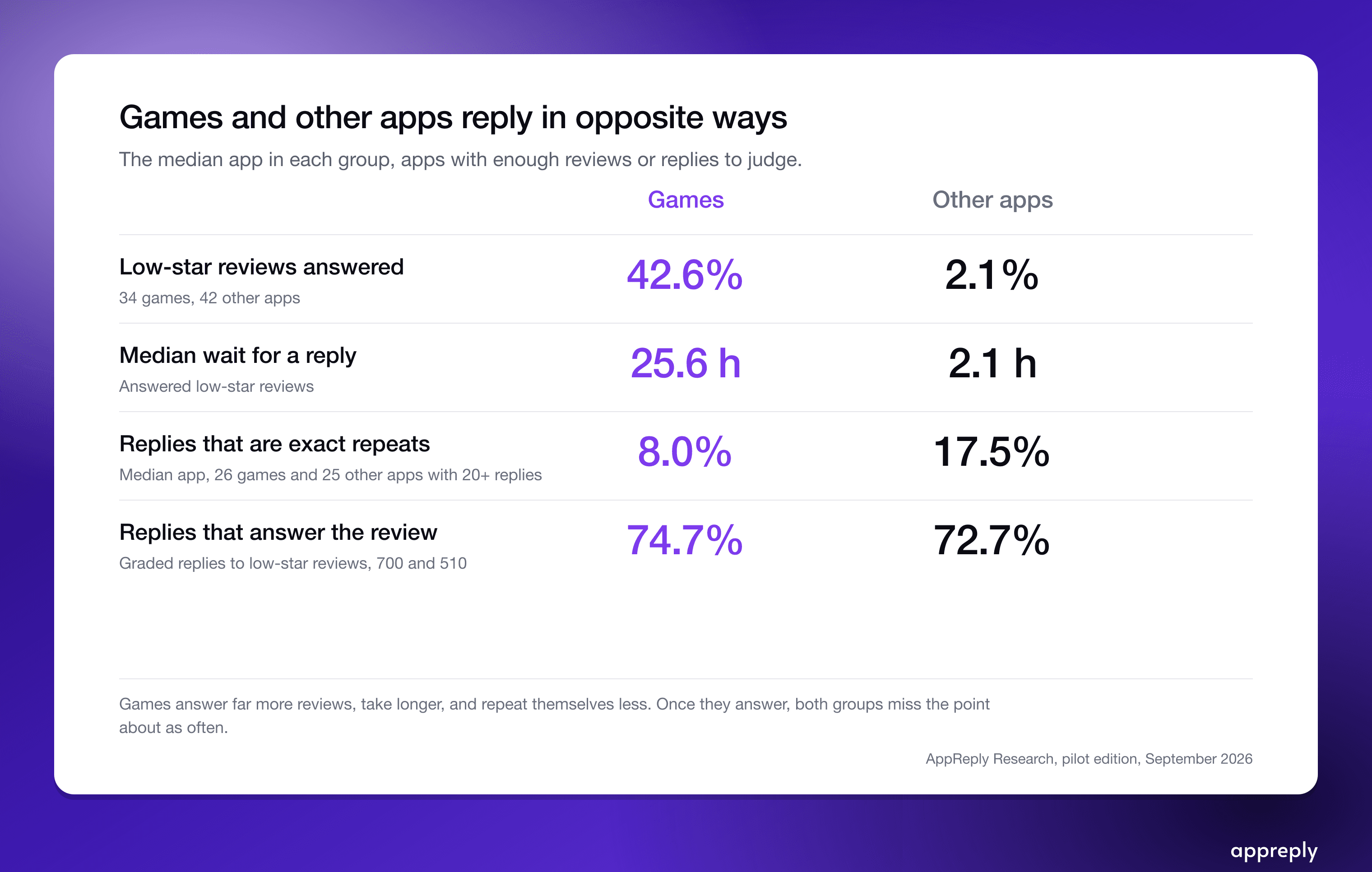 Answering more, answering faster and answering well are three different things.
For the 10,300 low-star reviews that did get a reply, the median wait was 6.8 hours. 61% of replies came within a day, 81% within three days.
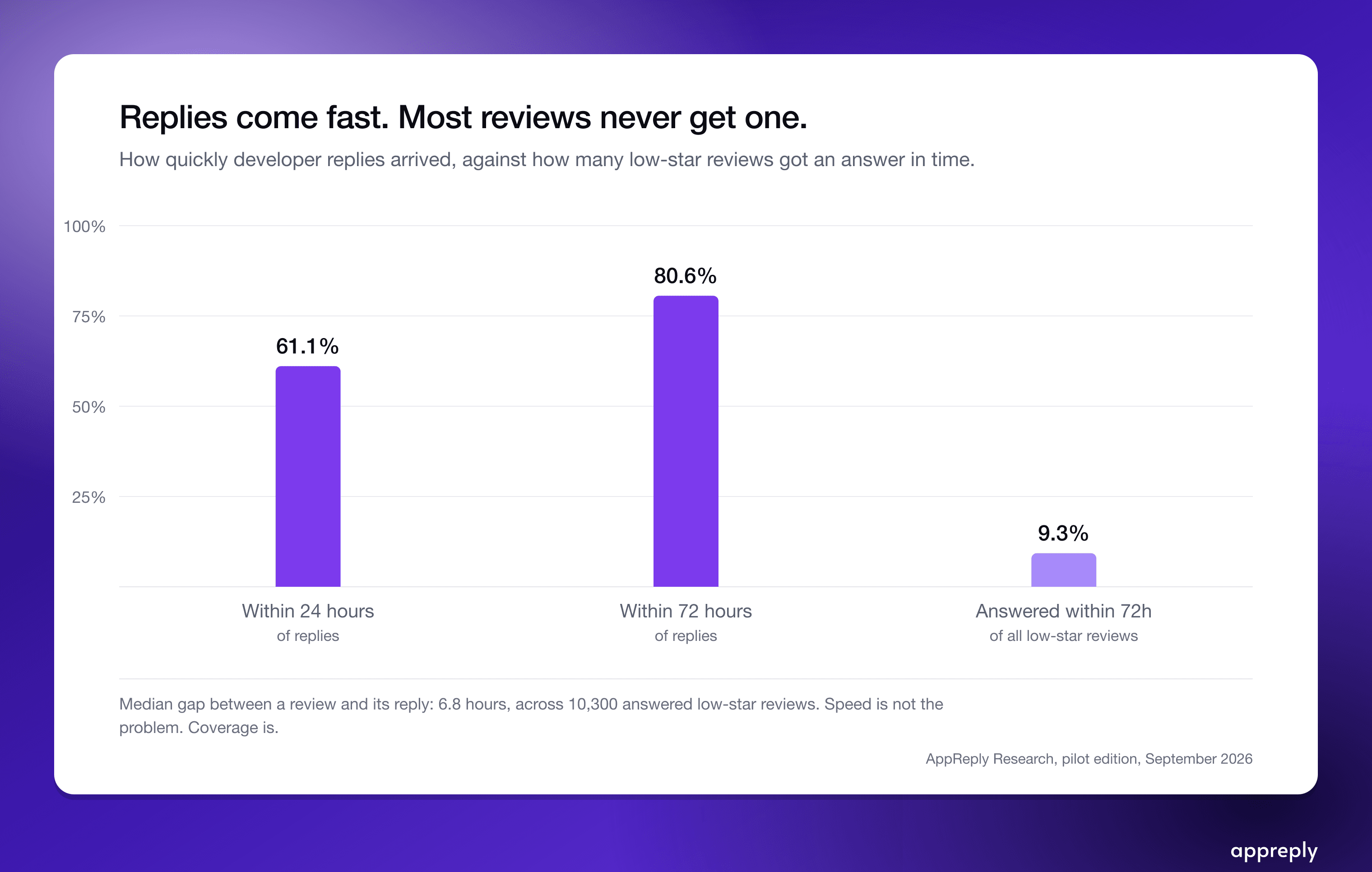 Fast replies, but only for the few reviews that get one.
Now count every low-star review, answered or not. Only 9.3% got a reply within three days. The teams that reply are quick. Most reviews just never reach one.
Almost half of all replies came within six hours. The rest trail out over days.
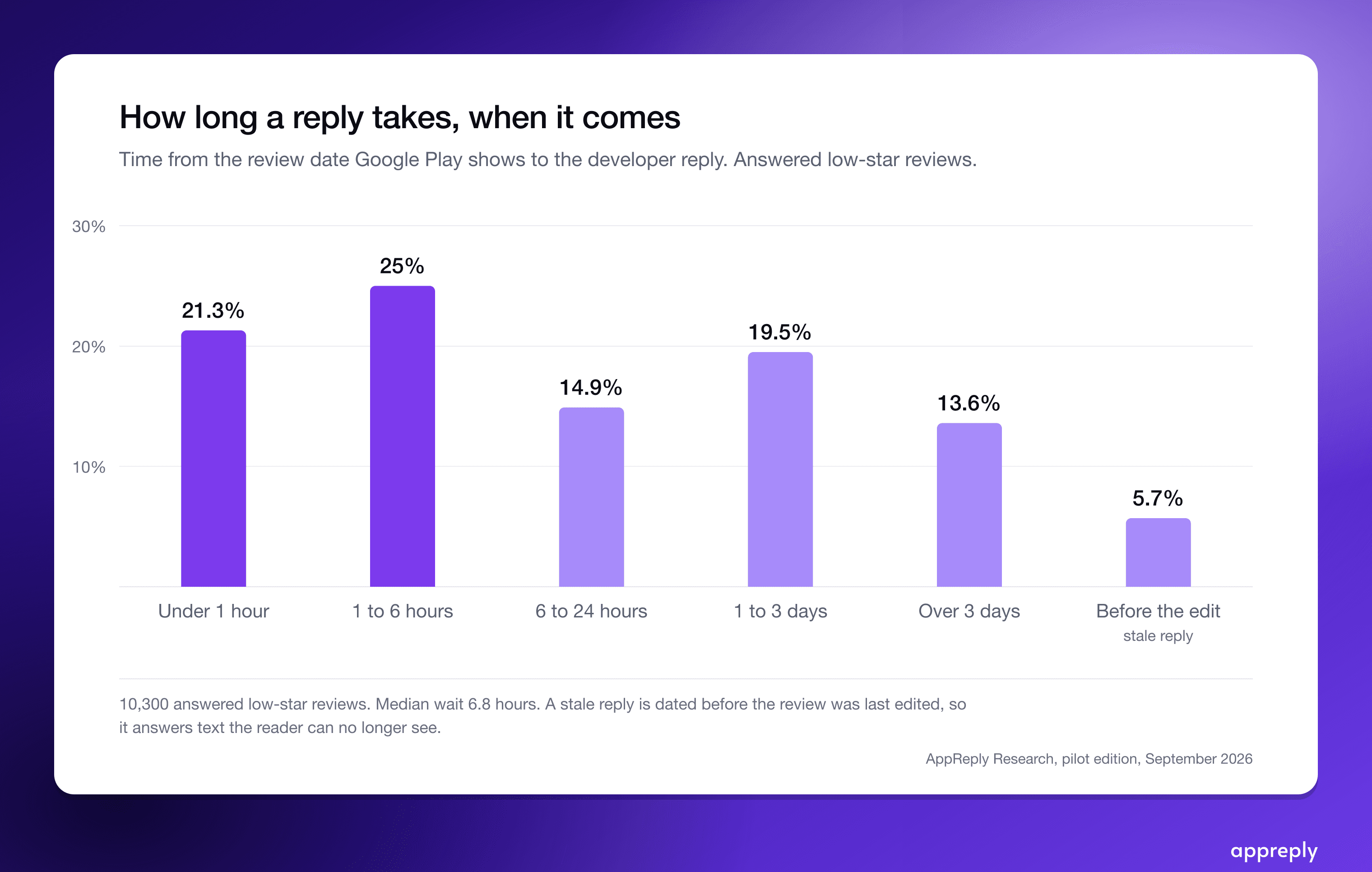 Almost half of replies land within six hours.
Google Play files each review under the language it was written in. German and English reviews got answered most often, Indonesian and Korean least.
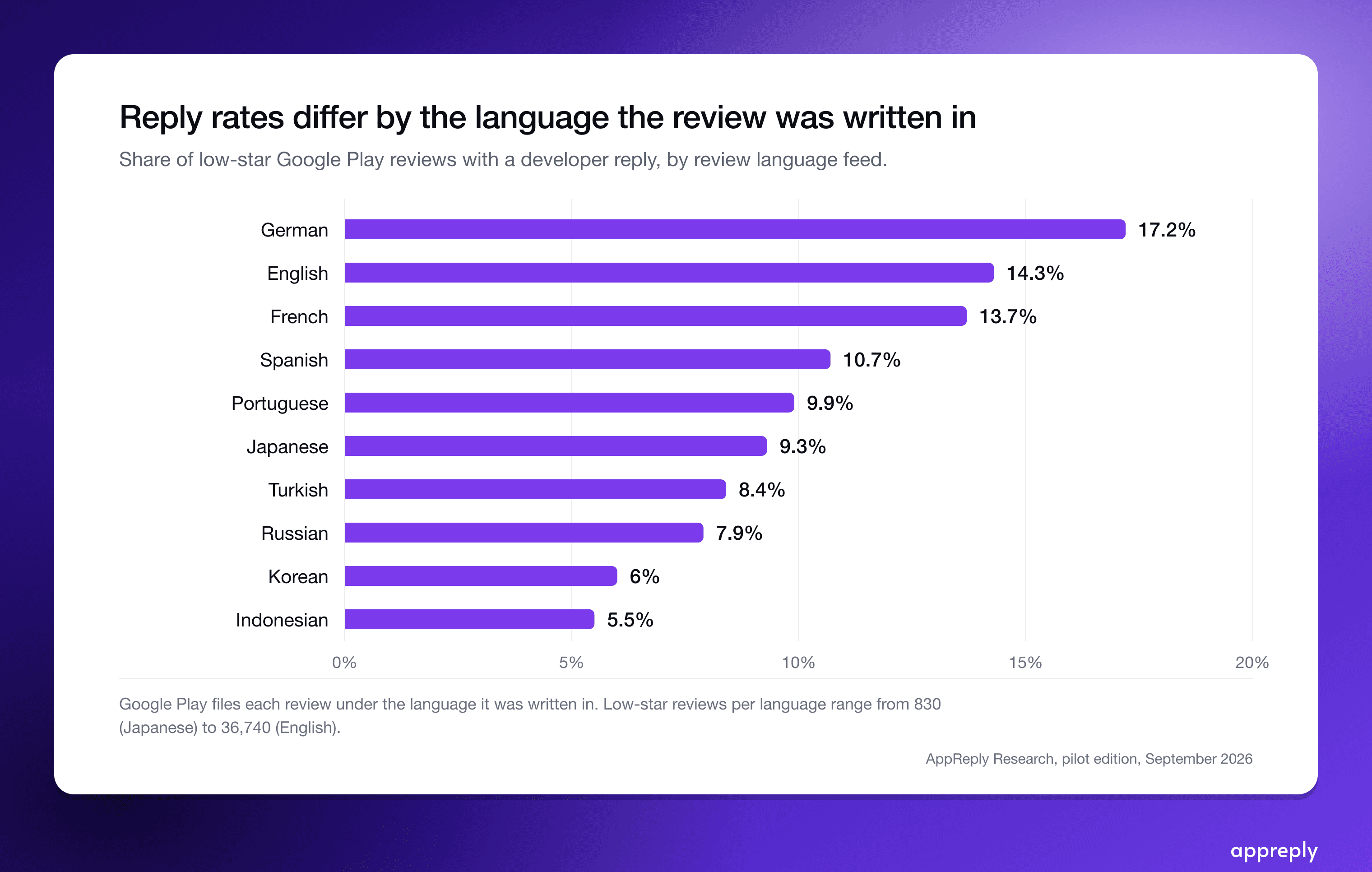 German and English reviews get answered most, Indonesian and Korean least.
Answering is one thing. Answering in the reviewer's language is another. Of 1,250 graded replies we could compare, 13.3% were in a different language from the review, and 96% of those were in English. Another 5.6% switched language halfway through.
Split by the language the review was written in, the pattern is clear. French and Spanish reviewers got a reply in the wrong language about 1 time in 5. English reviewers never did.
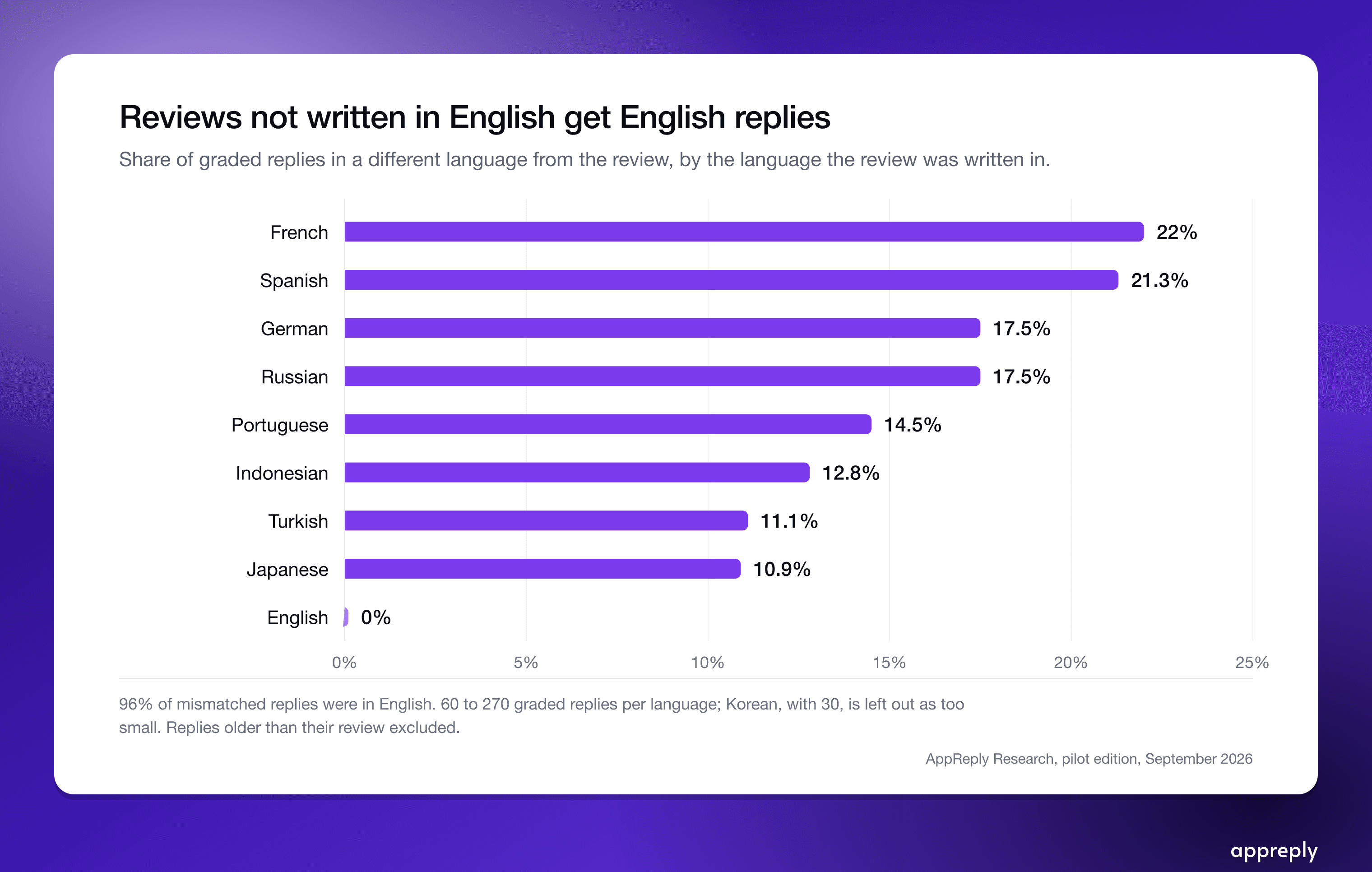 The further from English, the more often the reply is in English anyway.
Someone writes to you in Turkish. You answer in English. They can tell nobody read it.
Across all 37,110 replies in the 30-day window, to reviews of any star rating, 42.3% repeated another reply from the same app exactly, letter for letter. The real share of canned replies is higher, because a template that adds the reviewer's name counts as unique here.
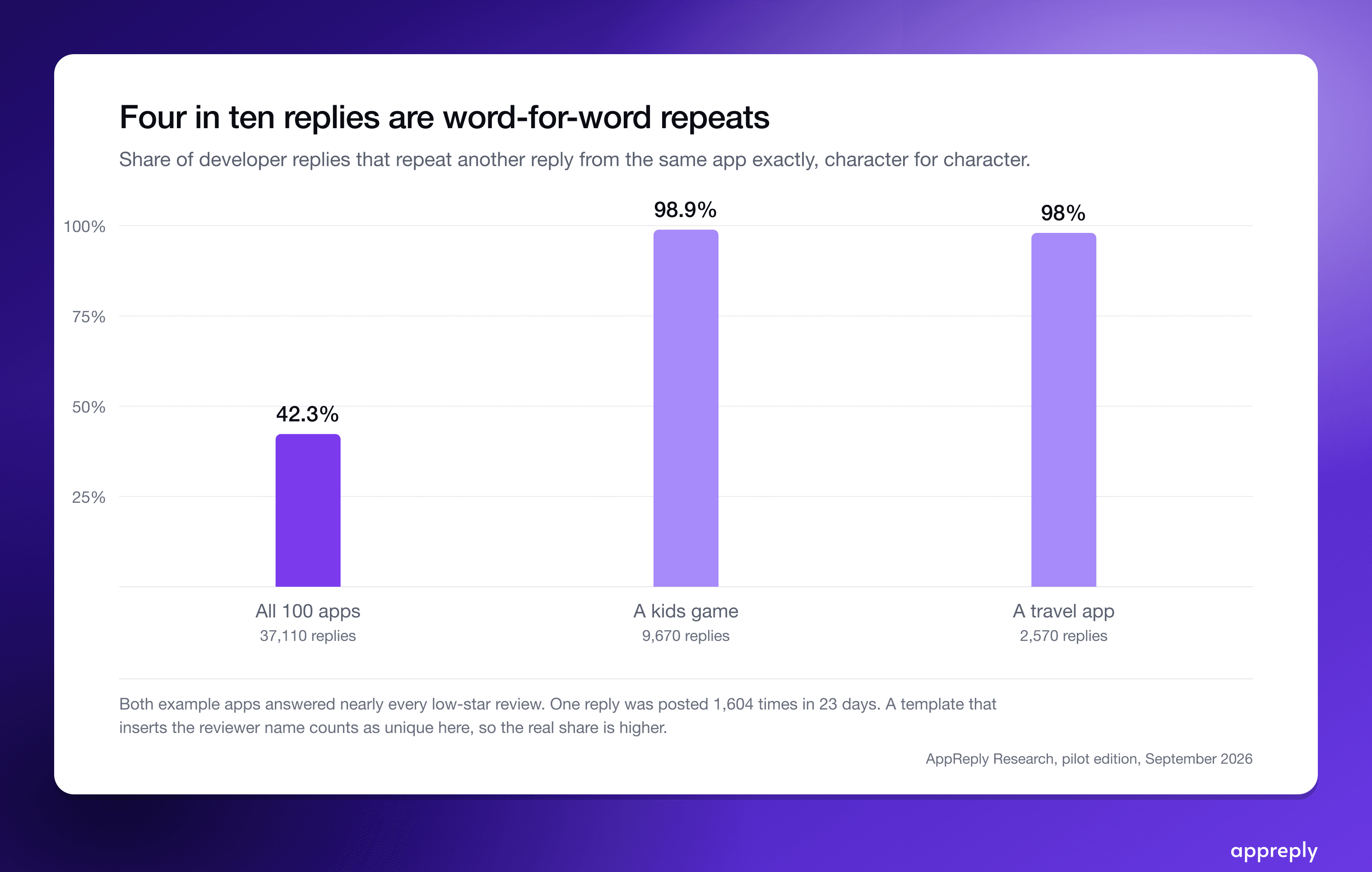 Some apps repeat almost every reply.
Two of the most repeated, with the apps left unnamed:
Thank you for your words and review. Our mission is to make it easier for everyone to experience the world, and your message tells us we're on the right path.
A travel app posted that 1,604 times in 23 days.
Thank you for your feedback. What can we do to get a higher rating from you?
A kids game posted that 313 times.
Both apps replied to nearly every low-star review. On a dashboard, their reply rate looks perfect. Now picture writing three paragraphs about a bug and getting back the same line as 1,603 other people. Replying to every review is not the same as answering it.
For each graded reply we asked one question: does it answer what this reviewer actually raised? 73.8% of replies to one to three star reviews did.
The harder the review, the more often the reply missed. Replies to one-star reviews passed 69.5% of the time. Replies to five-star praise passed 95.1%, because thanking a happy reviewer is easy.
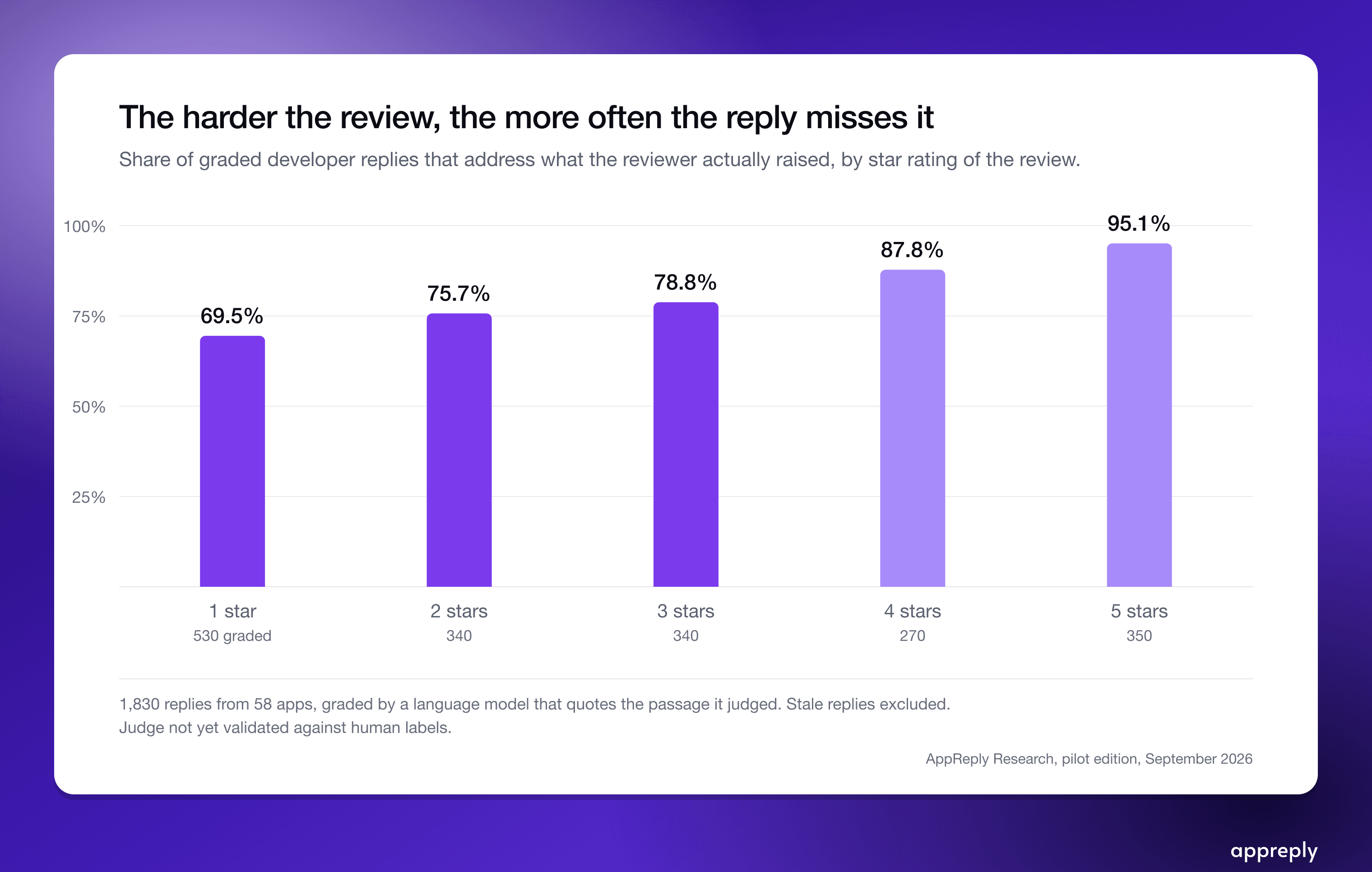 The angrier the review, the more often the reply misses it.
Every failing verdict had to quote the reply, so we can say how replies missed, not only how often:
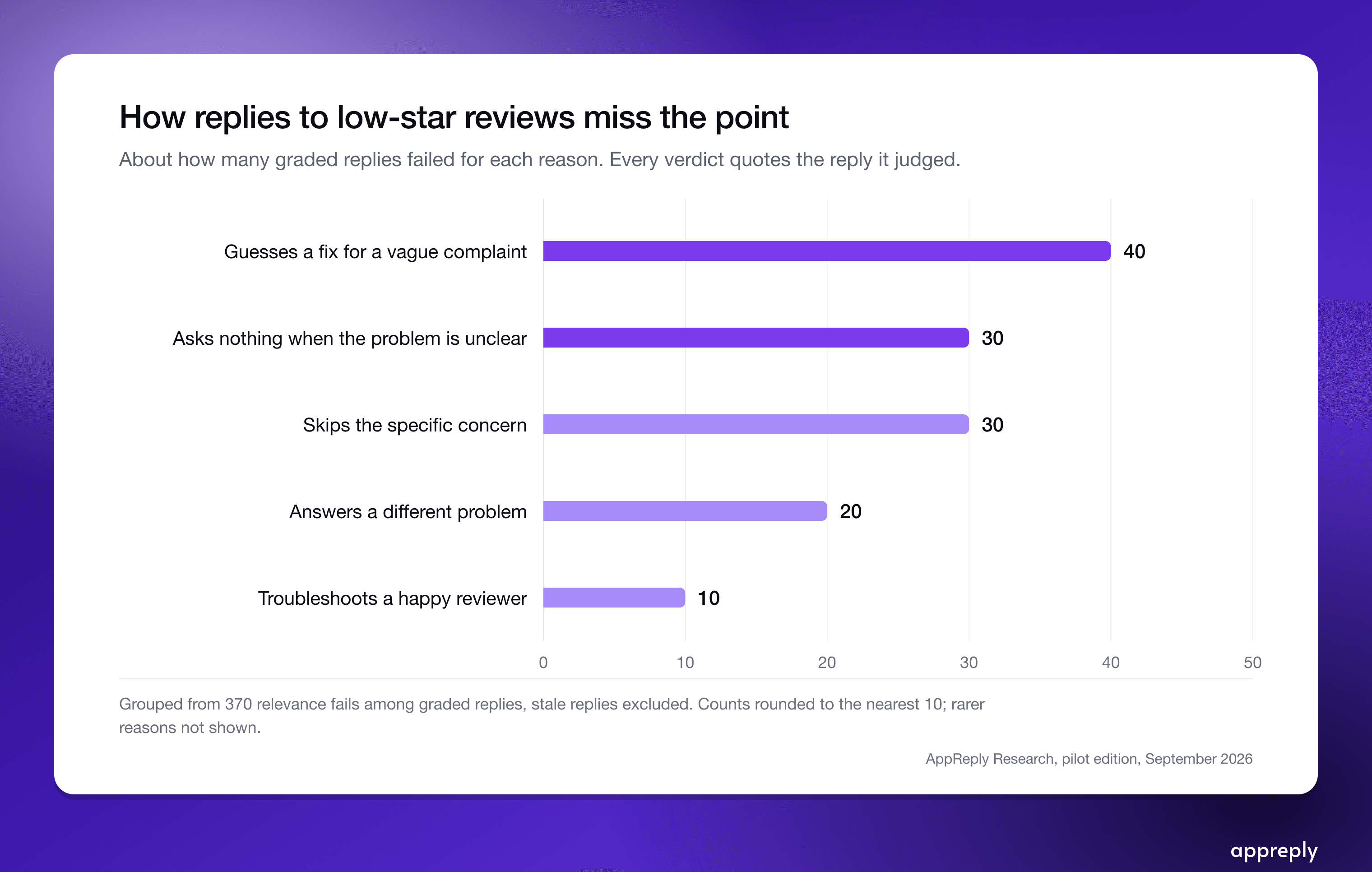 Most misses come from guessing instead of asking.
The top two are one mistake seen from two sides. A reviewer says the app is bad. One reply sends five troubleshooting steps for a problem nobody described. Another says thanks and asks nothing. One question about what went wrong beats both.
About 1 reply in 18 is older than the review above it. The reviewer edited their review after the developer answered, so the reply now answers words the reader cannot see.
Among the replies we sampled, it was 13%, and 21% under five-star reviews. Picture a reply that apologises for a crash, sitting under a review that now says the app is great. It reads as if nobody is watching.
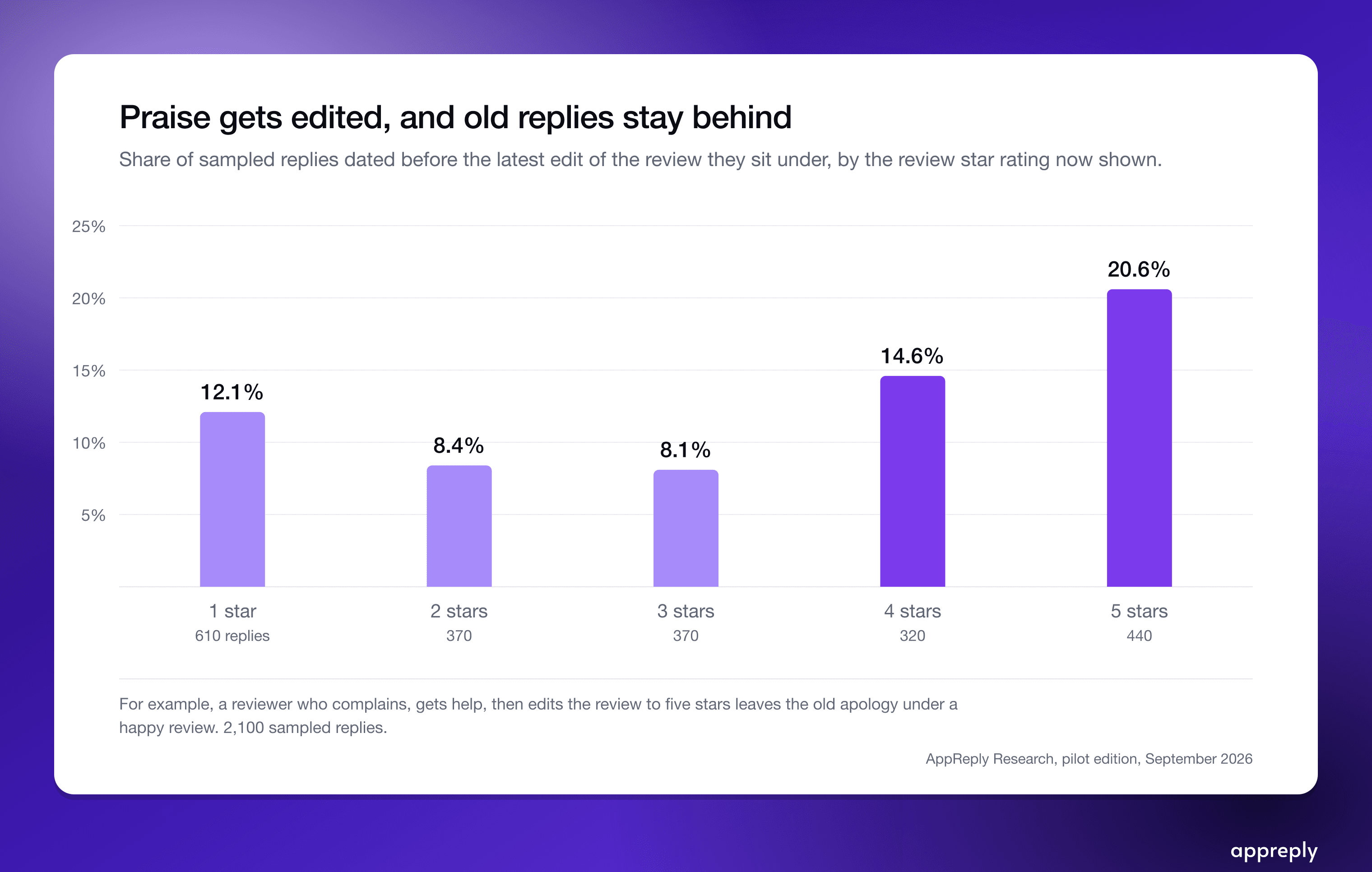 Stale replies pile up under the reviews that got better.
12 of the 58 graded apps asked at least one reviewer to raise their rating, in about 80 replies. Some asked outright what it would take to earn five stars. We report this separately from whether the reply answered the review, because a reply can do both. We still advise against it, and explain why in our reputation management guide.
Put the numbers side by side and five lessons stand out. None of them is about writing nicer replies.
Replying is a decision, not a skill. Apps sit at 0% or above 90%, almost never in between. Coverage comes from whether a team set up a way to answer reviews, not from how hard it tries.
Speed is solved. Coverage is not. The teams that reply do it within hours. The gap is the reviews that never reach a team at all.
A full reply rate can hide an empty one. Templates fill the number without answering anyone. Reply rate alone cannot tell a team that reads every review from one that pastes the same line under it.
The harder the review, the more replies guess. Praise is easy to answer. Complaints get troubleshooting for problems nobody described, or a thank-you that asks nothing. Asking one question would fix most of it.
Scale breaks language first. When replies go wrong across languages, they go wrong the same way: an English answer to someone who wrote in their own language.
Some apps got it right. These had at least 30 graded replies to low-star reviews and the highest share that answered the reviewer. They are examples, not a ranking.
| App | Answers the review | Low-star reviews answered | Repeated replies |
|---|---|---|---|
| Angry Birds Friends (game) | 90.0% | 100% | 0.6% |
| Dopples World (game) | 87.5% | 99.1% | 0.0% |
| Warline: Sniper Strike (game) | 83.0% | 84.6% | 4.4% |
| Crunchyroll (app) | 82.6% | 98.1% | 0.0% |
| Zynga Poker (game) | 82.1% | 100% | 0.0% |
Look at the last column. None of these five leans on templates.
Two replies that passed, with reviewer names removed. A two-star review of a mobile game:
Yeah, it's a clone of that same base building game we've all played over and over. Fun for about 10 hours. The sniper action mini games are great, though.
Great to hear the sniper action mini games hit the mark for you. We understand the rest felt like a familiar base-building formula that stopped being fun after about 10 hours. We'll keep looking at where the game falls short and work on it.
And a one-star review:
I love this game but even tho my internet is on I cant unlock stuff with ads and I really want it it
Hello [name], we're glad you love the game! If ad-unlocked items aren't working even with an internet connection, please update the game and restart your device. If it continues, contact [email protected] so we can look into it.
Both say the reviewer's point back in the reviewer's own words. The first takes the criticism without arguing. The second gives one clear next step. Neither could be pasted under any other review.
Every item comes from something this study measured. Run your last 50 replies to low-star reviews through it.
By hand, this works for a few hundred replies. Past that, you need the checks to run for you. Reply Quality grades every reply against a checklist you write and quotes the words behind each verdict. If you use auto-replies, our guide to getting AI auto-replies close to 100% quality shows how to check every draft before it goes out.
Which apps. We read all 108 US top free and top grossing charts on Google Play, one per category, and kept the top 10 of each: 887 apps. From those we drew 100 across ten bands of rating count, counting the busiest band twice so the apps most people see were well represented. One app had no reviews in the period.
Which reviews. Google Play keeps a separate review feed for each language. For each app we read ten: English, Spanish, Portuguese, German, French, Russian, Japanese, Korean, Indonesian and Turkish, newest first, until a whole page fell before the window. Every review was stored with its text, stars, date and any developer reply, exactly as served. That was 848,200 reviews dated 16 August to 8 September 2026, read on 15 September.
The week rule. A reply only counts if the developer had time to write it, so reply rates use reviews dated 7 to 30 days before we read the store. Google Play shows the date of a review's latest edit, not when it was first written, so we make no claim about review age beyond that date.
Which reviews count for reply rate. One to three stars with at least 25 characters of text: the reviews where a reply has something to answer. That left 89,330. Replies to four and five star reviews are reported separately.
How replies were graded. From each app we drew replies across star ratings and languages, at least two per combination where possible. Plain code checked four things: leftover template text, formatting, mentions of another store, and requests for a higher rating. A language model judged three: does the reply answer what the reviewer raised, is it in the reviewer's language, and does it stay in one language. Every verdict had to quote the part of the reply it judged.
Replies older than their review. 271 drawn replies were dated before the review above them, because the reviewer edited the review afterwards. They answer text the reader can no longer see, so we left them out of every quality figure, leaving 1,830 graded replies from 58 apps.
Anonymisation. We collected only what Google Play shows publicly: review text, stars, dates and developer replies. Reviewer names were removed from every quote in this report, and no review is published with its author. Review and reply text was sent to the grading model's provider with response storage turned off, and nothing else about reviewers was collected. Apps are named only as examples of good replies.
Rounding. Shares to one decimal place. Review and reply counts to the nearest 10. App counts, and anything about a named app, are exact.
Definitions we used
| Term | What it means here |
|---|---|
| Low-star review | 1 to 3 stars, at least 25 characters, dated 7 to 30 days before the store was read |
| Answered | A developer reply was on the review when we read it |
| Reply within 72 hours | Reply dated no more than 72 hours after the review, and not before it |
| Repeat | Exactly the same reply text posted by the same app to another review in the window |
| Answers the review | The grader judged that the reply responds to what the reviewer raised, quoting the reply |
| Stale reply | A reply dated before the latest edit of the review it sits under |
| Asked for a higher rating | A phrase match for a request to raise the rating, checked by a model when unclear |
State of app review replies is a quarterly report from AppReply Research on how developers answer their reviews. This page always carries the latest edition. Past editions stay online, unchanged, at their own dated address, so a number you cite today will still be there next year.
The next edition reads about 10,000 apps, not 100. It will compare apps and games in depth, list the most repeated replies across the store, check the grader against human raters, and publish its method with a timestamp before collecting any data.
To cite this edition: AppReply Research, State of app review replies, Q3 2026 edition (pilot), September 2026, appreply.co/blog/app-review-reply-benchmark.
Corrections. If a figure about your app is wrong, tell us with the app's store link. We correct facts, not results.
Want the next edition the day it lands? Tell us where to send it.
Bring monitoring, full Analytics, MAX, and Reply Quality into one app review workflow.

What we learned managing app store reviews at scale — battle-tested frameworks, fake review playbooks, and workflows for high-volume publishers (2026).

How to automatically reply to App Store and Google Play reviews without breaking brand rules. The setup that gets AI replies for mobile apps and games close to 100% quality: approved examples, current docs, narrow rules, a scorecard checked before publishing, and flags you read.