Loading. Please wait...
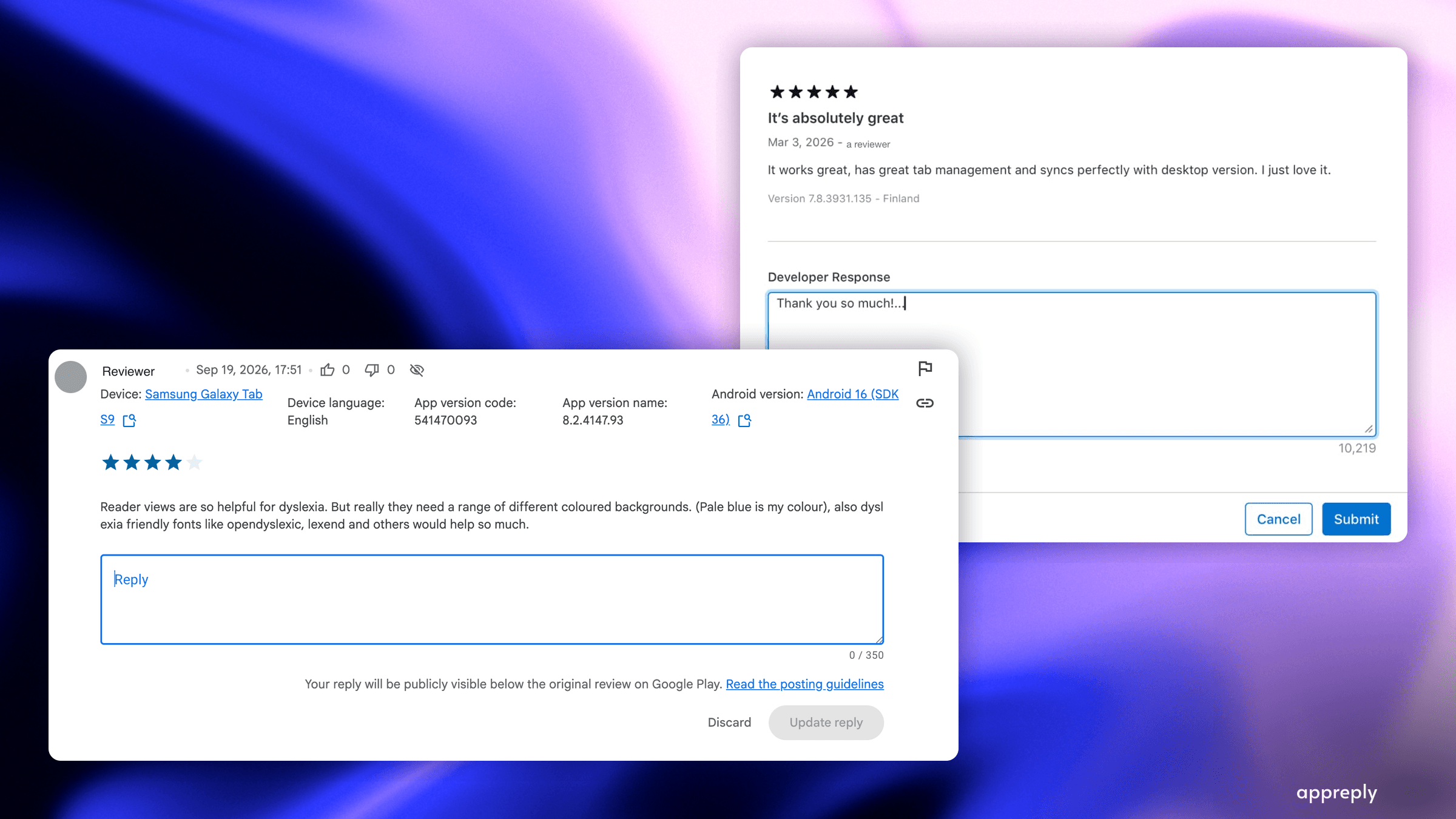
A developer reply is public writing with your company's name on it, and in 2026 the stores read it too. This guide covers how to reply on the App Store and on Google Play, who needs which permission, what the 350 character limit and the 24 hour delay change about your writing, how to answer eight kinds of review with real examples, when a reply can ask for a better rating, and how to keep quality up once you are past a few hundred replies a month. Our 2026 study of 100 top apps is the backdrop: 8 in 9 low-star reviews get no reply at all, and 42% of the replies that do go out are word-for-word repeats.
A reply used to be customer service. In September, a breakdown of Google's app quality audit described a score that reads your reviews, and one of the things it weighs is whether your replies are templated or personal. The app in its case study answered 100% of its reviews and still scored medium, because every answer was the same paragraph.
So picture the reviewer who writes that your app crashed and cost them an afternoon. What you type back sits under their words for as long as the review is there, with your company's name on it, read by everyone deciding whether to install, and now by the store itself.
Most teams never get that far. On Google Play, about 8 times in 9, nobody answers at all.
This guide starts with what to write, because that is the part the stores now read and the part most teams get wrong. Then where the button lives in each console, how the two differ, and what to do when the volume passes what a person can read.
Before the how-to, the bar. We read 848,200 reviews across 100 top Google Play apps and graded 1,830 developer replies. Three findings shape everything below.
Coverage is the first problem. Of 89,330 low-star reviews with real text, 11.5% had a reply a week later. Apps split hard: of the 76 we could judge, 24 answered none and 18 answered nine in ten or more. Replying is a decision somebody makes once, not a skill teams slowly acquire.
Speed is not the problem. When a reply came, the median wait was 6.8 hours and 61% arrived within a day. Any team that decides to answer is fast enough.
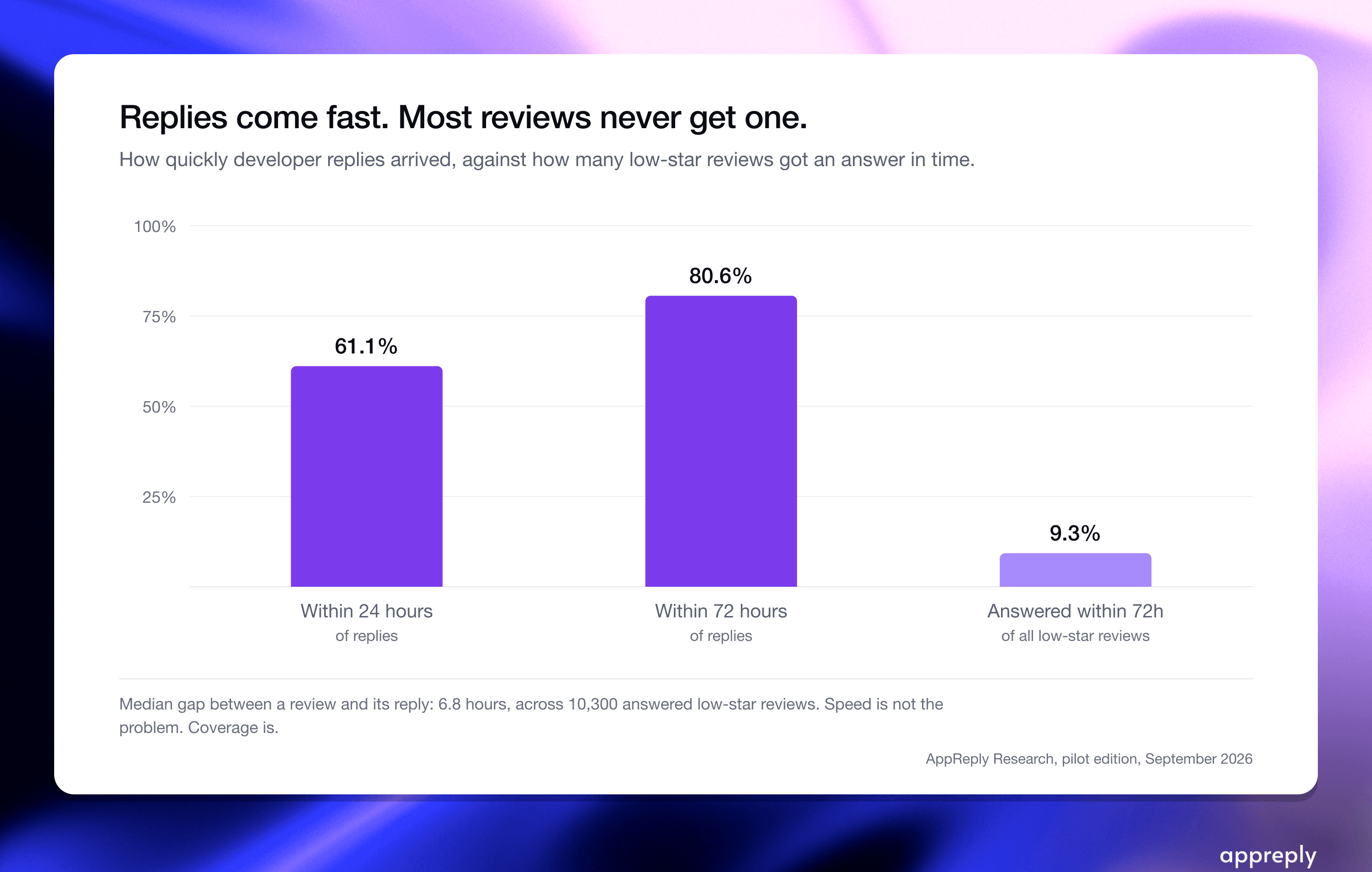 When developers answer at all, they answer quickly. Almost half of replies land within six hours.
Quality is the second problem. 42% of all replies repeated another reply from the same app word for word, and one travel app posted the same sentence 1,604 times in 23 days. Among graded replies to low-star reviews, 73.8% answered what the reviewer raised, which leaves about 1 in 4 that did not.
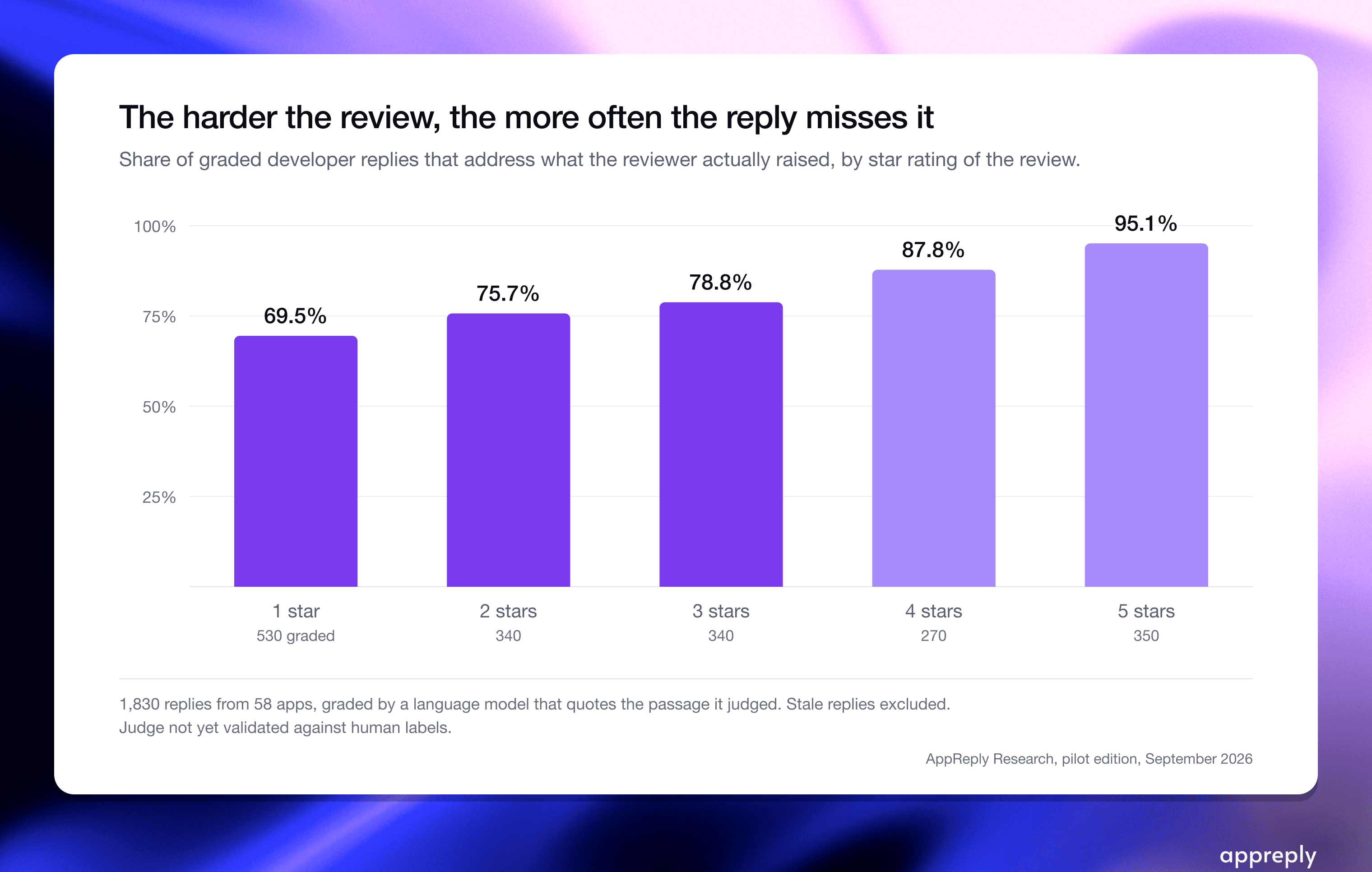 The angrier the review, the more often the reply misses what it was about.
Notice where the misses are. Praise is answered well because thanking someone is easy. One-star complaints, the reviews most people read, are where replies guess.
Every reply that works does the same four things, in about the same order.
Name the problem in the reviewer's own words. Not a category, the actual thing. "Losing your export halfway through" beats "the issue you experienced". This is the part that proves someone read it, and it is the part templates cannot fake.
Say what is true about it. Fixed in a named version, being worked on now, or not something you are going to change. All three are fine. Inventing a fourth answer is not.
Give exactly one next step. Update to 5.1.2. Email support with your device model. Check this setting. One. A reply with three options is a reply nobody acts on.
Stop. Google Play caps a reply at 350 characters, which is about two or three sentences, and the App Store allows far more room than you need. No timeline promises, no roadmap commitments, no paragraph about your team's values. Every promise in a public reply is a liability the day plans change.
Then run the paste test: could this reply sit under a different review without changing a word? If yes, it is a template with extra steps, and both the reviewer and the store can tell.
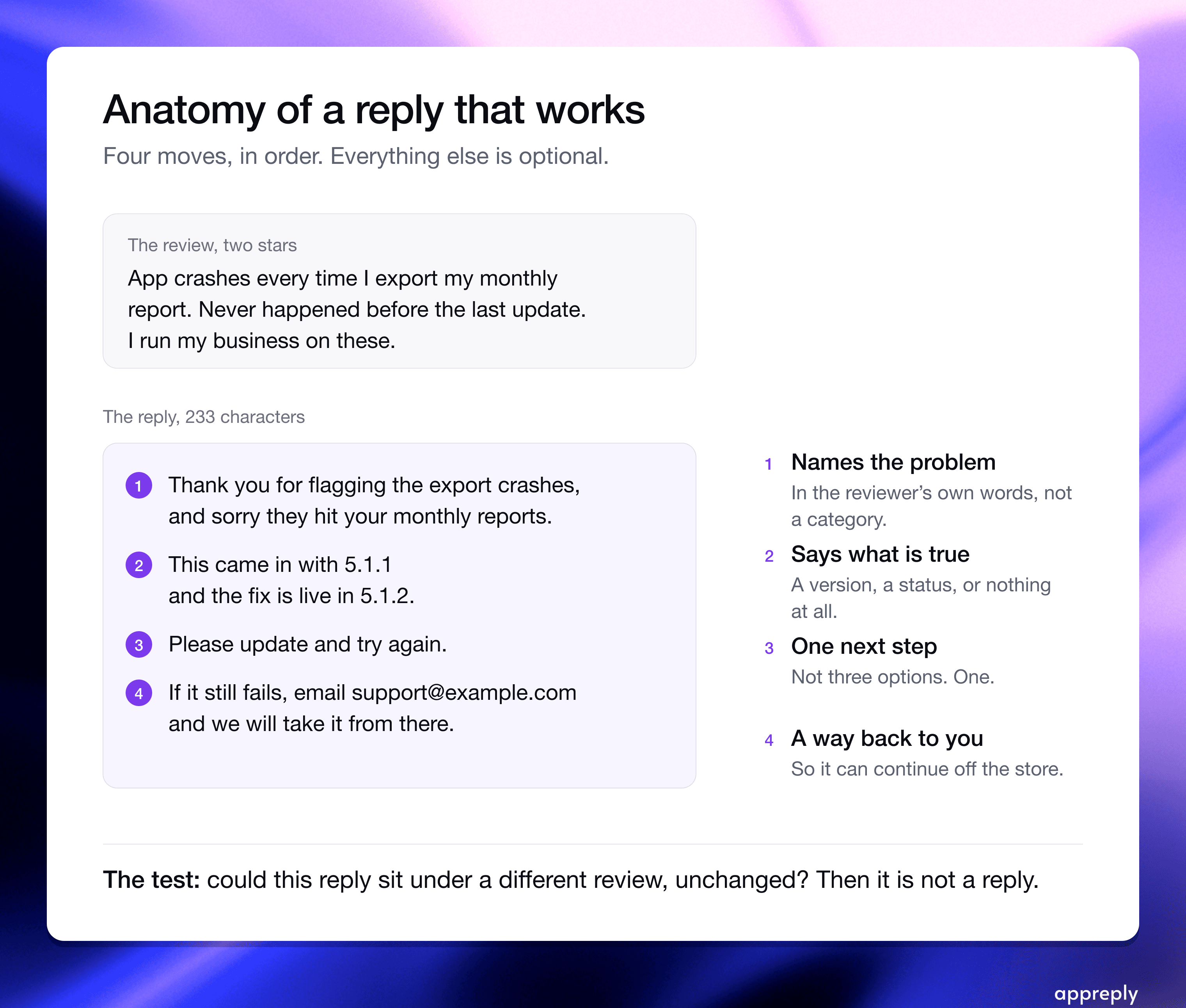 The same four moves on a real complaint, and the test that catches a template pretending to be a reply.
Two habits to drop. Blanket apologies read as boilerplate the moment someone scrolls three of your replies in a row, so acknowledge the impact factually instead. And never explain your internal process. "Escalated to engineering" tells the reviewer nothing they can use.
App crashes every time I export my monthly report. Never happened before the last update. I run my business on these.
Weak: "Thanks for your feedback! Try reinstalling the app or clearing your cache."
Better, and inside 350 characters: "Thank you for flagging the export crashes, and sorry they hit your monthly reports. This came in with 5.1.1 and the fix is live in 5.1.2. Please update and try again. If it still fails, email [email protected] and we will take it from there."
Bug reports are the reviews worth answering first. They tell you what is costing you retention, and the reply is the only public evidence that you fixed it.
Charged again after I deleted the app. This is a scam.
Do not argue with the word scam, and do not accept blame for a store's billing flow. State how it works, then hand them the one path that resolves it: "Deleting the app does not cancel a subscription, it is managed by Google Play. Open Play Store, Subscriptions, and cancel it there. If it shows cancelled and you were still charged, email [email protected] with the order number and we will sort it out."
Route these to your helpdesk too, where an agent can look at the account. Zendesk and Intercom can create the ticket from the review and bring the agent's answer back.
Would be 5 stars if you could export to PDF.
Answer honestly about status without promising a date: "PDF export is the request we hear most and it is on our list, though I cannot give you a date yet. In the meantime, the share sheet will send a formatted copy to any app that accepts documents." One request is anecdote. Fifty are a roadmap signal, which is a job for review analytics rather than replies.
A rating with no words is the most common review you will see, and there is nothing in it to answer. Reply anyway, in one sentence, and ask a question: "Sorry to see the one star. What went wrong? Tell us here or at [email protected] and we will fix what we can."
In our study, the most common way a reply missed the point was guessing at a problem nobody described. One question beats five troubleshooting steps.
TERRIBLE. Paid for premium and half of it does not work. DO NOT BUY.
Do not match the tone, do not defend, do not say "sorry you feel that way". Acknowledge the substance and offer the exit: "Paying for premium and not getting it is not acceptable. Email [email protected] with which features are failing and we will fix them or refund you." You are writing for the next reader as much as for this one.
Best budget app I have tried. Widgets are great.
Keep it short and specific, and add one thing they might not know: "Glad the widgets are working for you. If you have not tried shared budgets yet, they use the same setup." Long replies to praise read as marketing.
Since the update I get kicked from every match and lost my 30 day streak. Bought the season pass yesterday, I want my money back.
Patch day is where reply quality collapses, because a hundred versions of this arrive at once and the temptation is one paragraph pasted a hundred times. The facts can be the same. The reply cannot: this player lost a streak and paid for a season pass yesterday.
"Getting kicked mid-match after an update is maddening, and losing the streak with it is worse. We are fixing disconnects on this version now, and picking the nearest server region usually helps meanwhile. For the season pass, you can request a refund from your order history in the Play Store."
Games answer their players far more than other apps do. In our study the median game answered 42.6% of its low-star reviews, against 2.1% for the median non-game app. The games workflow is a different sport, and volume is why.
Reply in the reviewer's language or do not reply. In our study, 13.3% of graded replies were in a different language from the review, and 96% of those were English. An English reply under a Turkish review tells that reviewer, and everyone reading, that nobody read theirs. If you cannot staff the languages you publish in, that is the clearest case for automation with a language check before anything goes public.
Apple documents these steps in App Store Connect Help.
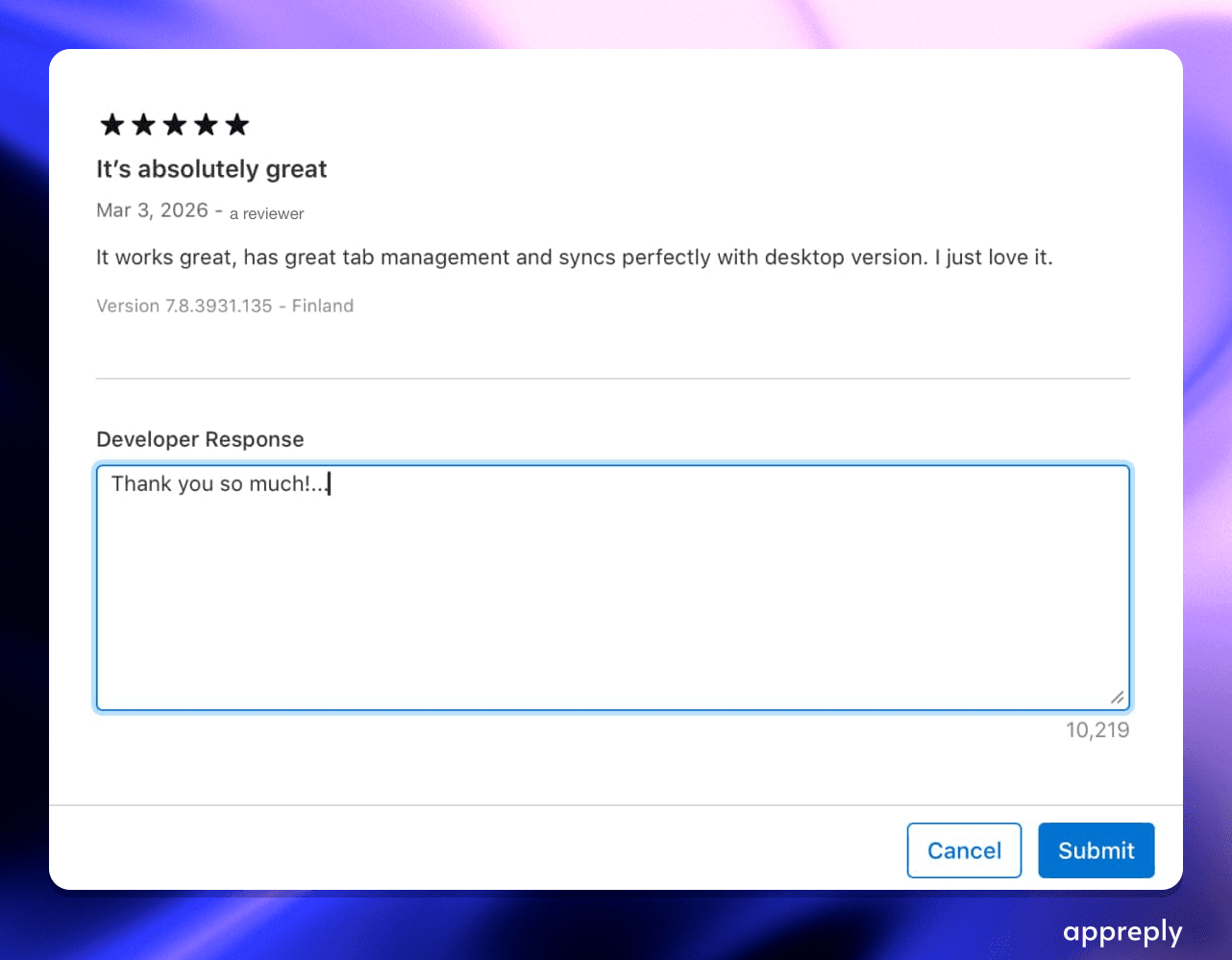 App Store Connect gives you 10,219 characters of room and up to a day before anyone sees the reply, so write the final version first time.
Four details change how you work:
Reviews are grouped by storefront country, so read each market on its own before you settle on a tone for it.
Google documents the same flow in Play Console Help, and the Reply to Reviews API does it programmatically if you would rather not live in the console. Play Console also offers a suggested reply on some reviews, generated from the review text. Treat it as a first draft, not an answer: it has never read your release notes or your refund policy.
Again, four details, and they are almost the opposite of Apple's:
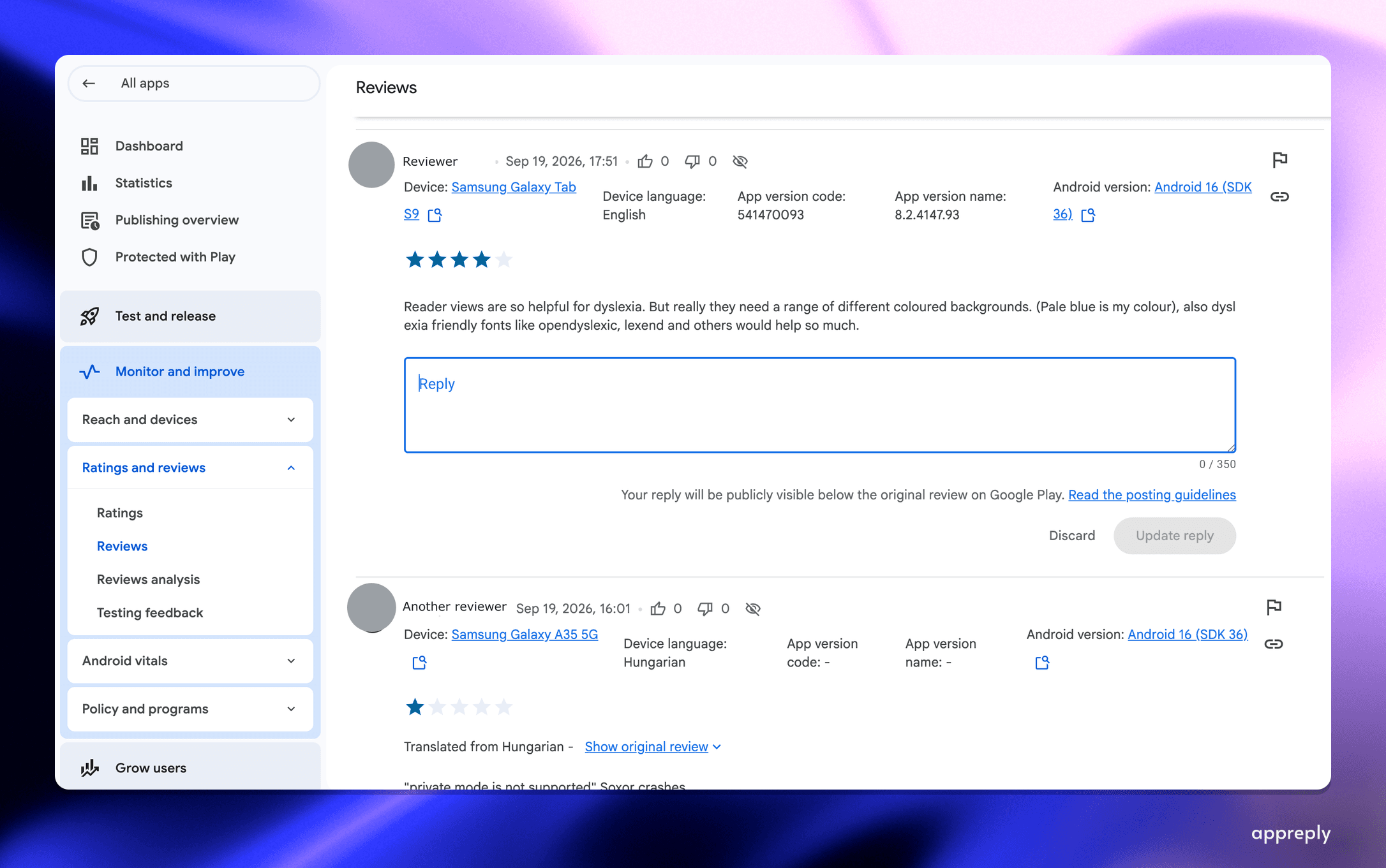 Monitor and improve, then Ratings and reviews, then Reviews. The counter starts at 0 of 350, and the reply goes public under the review with no draft state to hide in.
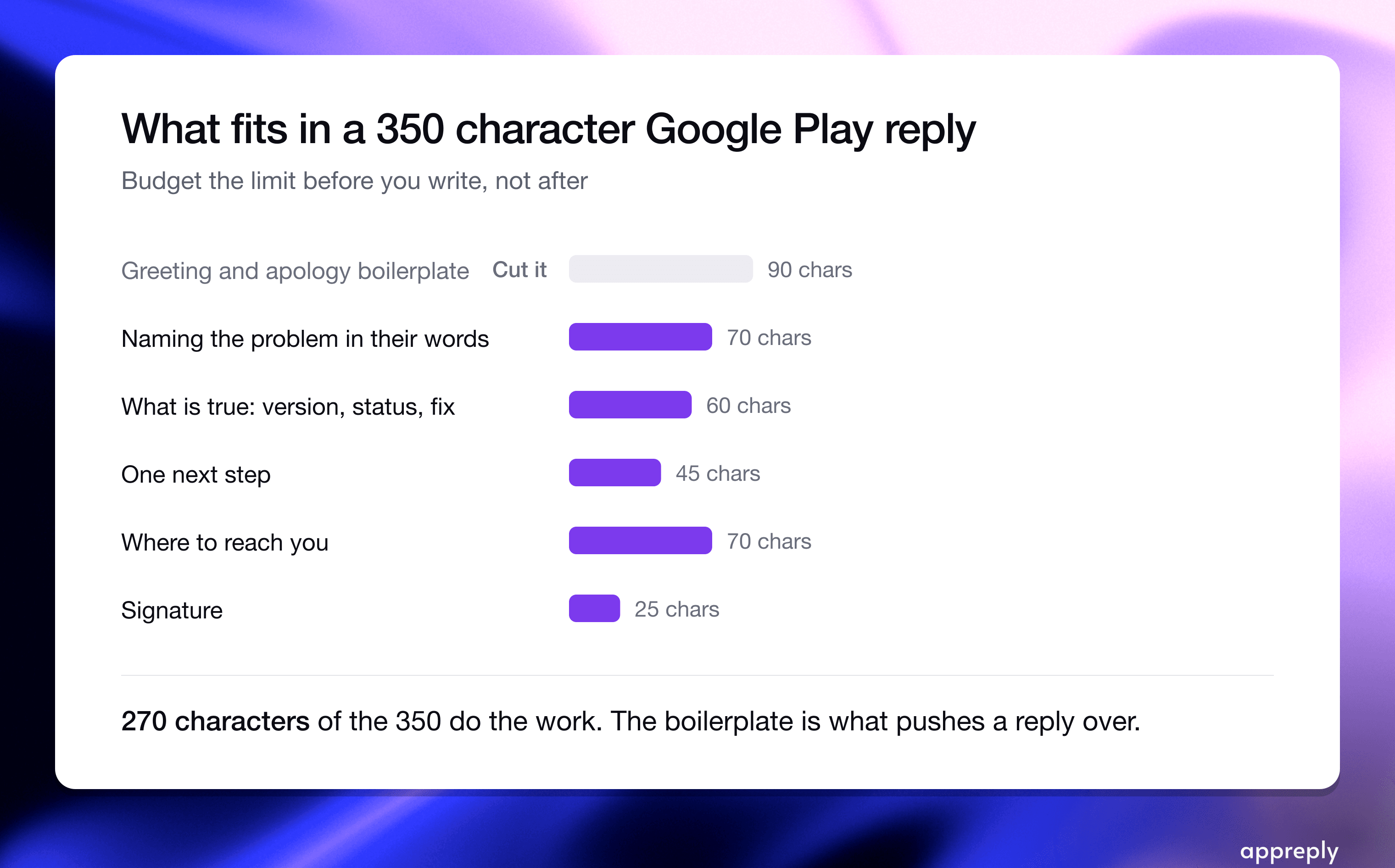 Boilerplate is what pushes a Google Play reply over the limit. Cut it and the substance fits.
Your reply has to follow Google's developer content policy, which rules out promotions, solicitations and anything off topic. Google Play indexes review text for search, and your reply sits in that text. Write the way the reviewer would describe the problem, which is usually the same phrasing other people search for. Never stuff keywords into a reply. A reply that reads as marketing fails the reviewer and looks worse to everyone scrolling past it.
| App Store | Google Play | |
|---|---|---|
| Where you reply | App Store Connect, or the API | Play Console, or the API |
| Who can reply | Account Holder, Admin, Customer Support | Anyone with the Reply to reviews permission, scoped per app |
| Character limit | 5,970 | 350 |
| When it appears | Up to 24 hours later | Immediately |
| Reviewer notified | Yes, on your first reply | Yes, on your first reply |
| Editing your reply | Allowed | Allowed |
| Reviewer editing theirs | Limited | Any time, and the date shown is the latest edit |
| Reviews grouped by | Storefront country | Review language |
| Review text indexed for search | No | Yes |
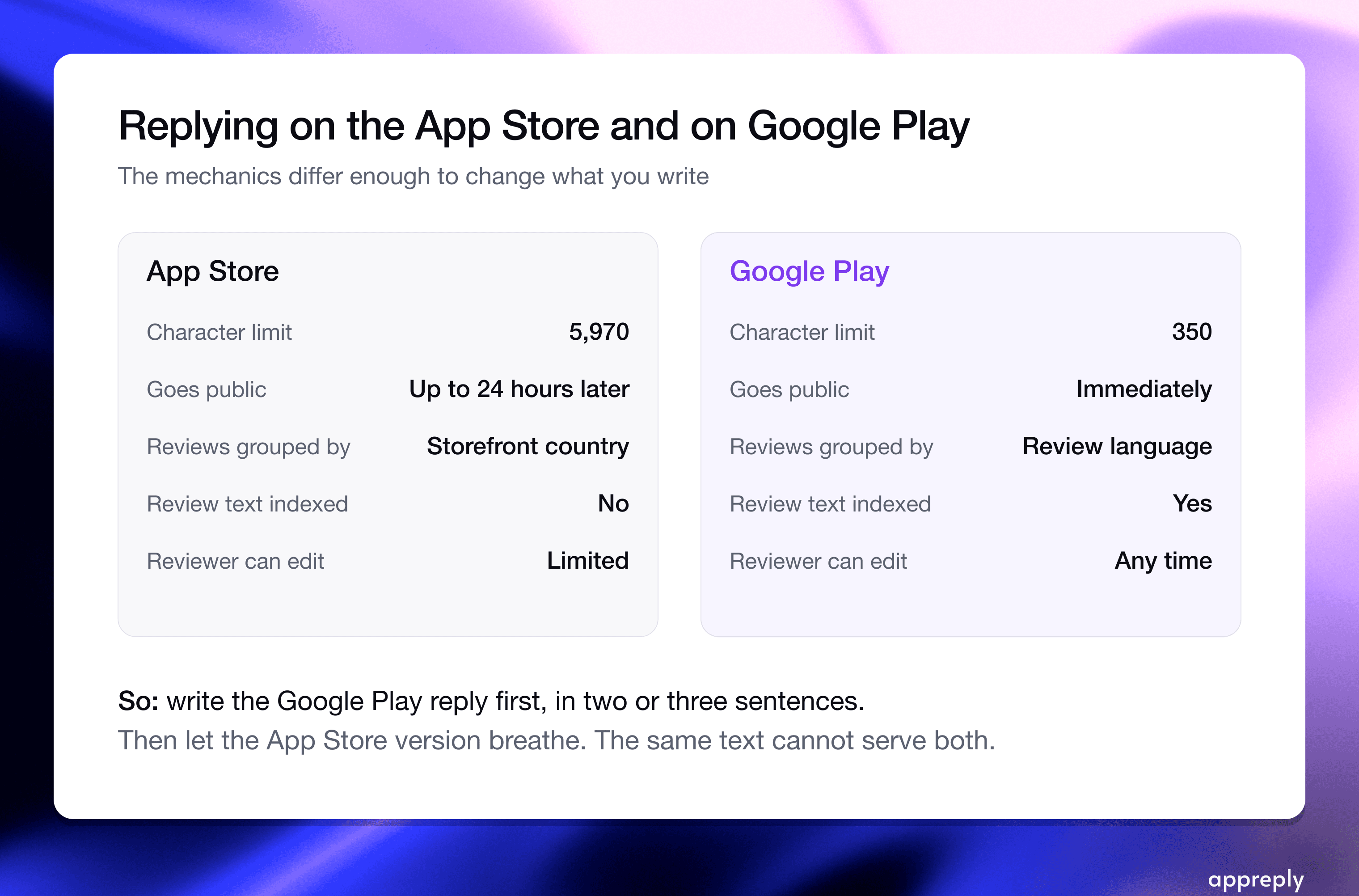 Two consoles, two sets of rules. Only the character limit is obvious; the rest quietly change your workflow.
Two practical consequences. First, the same answer cannot serve both stores: a reply written for Apple gets truncated on Android, and a reply written for Google Play looks curt next to the room Apple gives you. Write the Google Play version first, then let the App Store version breathe.
Second, Google Play's edit behaviour quietly creates stale replies. In our 2026 study, about 1 reply in 18 was dated before the review above it, because the reviewer edited afterwards. Those replies answer words the reader can no longer see. When a review changes, read it again.
One case only: a review that is clearly happy in both tone and topic, sitting under a low star count. "Love it, works great" at two stars is often a mis-tap, or a market where four stars is high praise. Thank them for the specific thing they liked, then ask lightly whether they would consider updating the rating.
Never under a complaint, and that includes a happy review that mentions a problem. There the ask reads as the reply's real purpose. For new ratings, ask inside the app with Apple's SKStoreReviewController or the Google Play In-App Review API, not in a reply: our reputation guide covers the prompt APIs and the timing.
Read your last fifty replies to low-star reviews in a row. That exercise alone tells most teams what they need to know.
If you cannot tell your replies apart, neither can the reviewer, and neither can a store summarising them.
The checklist works by hand up to a few hundred replies a month. Past that, a team publishing 800 replies a week would spend most of a working day just reading them, and nobody on a small team can properly check a Polish or Turkish one.
The way out is not to read faster. It is to write your standard down once and have every reply checked against it, whether a person or an AI draft wrote the words.
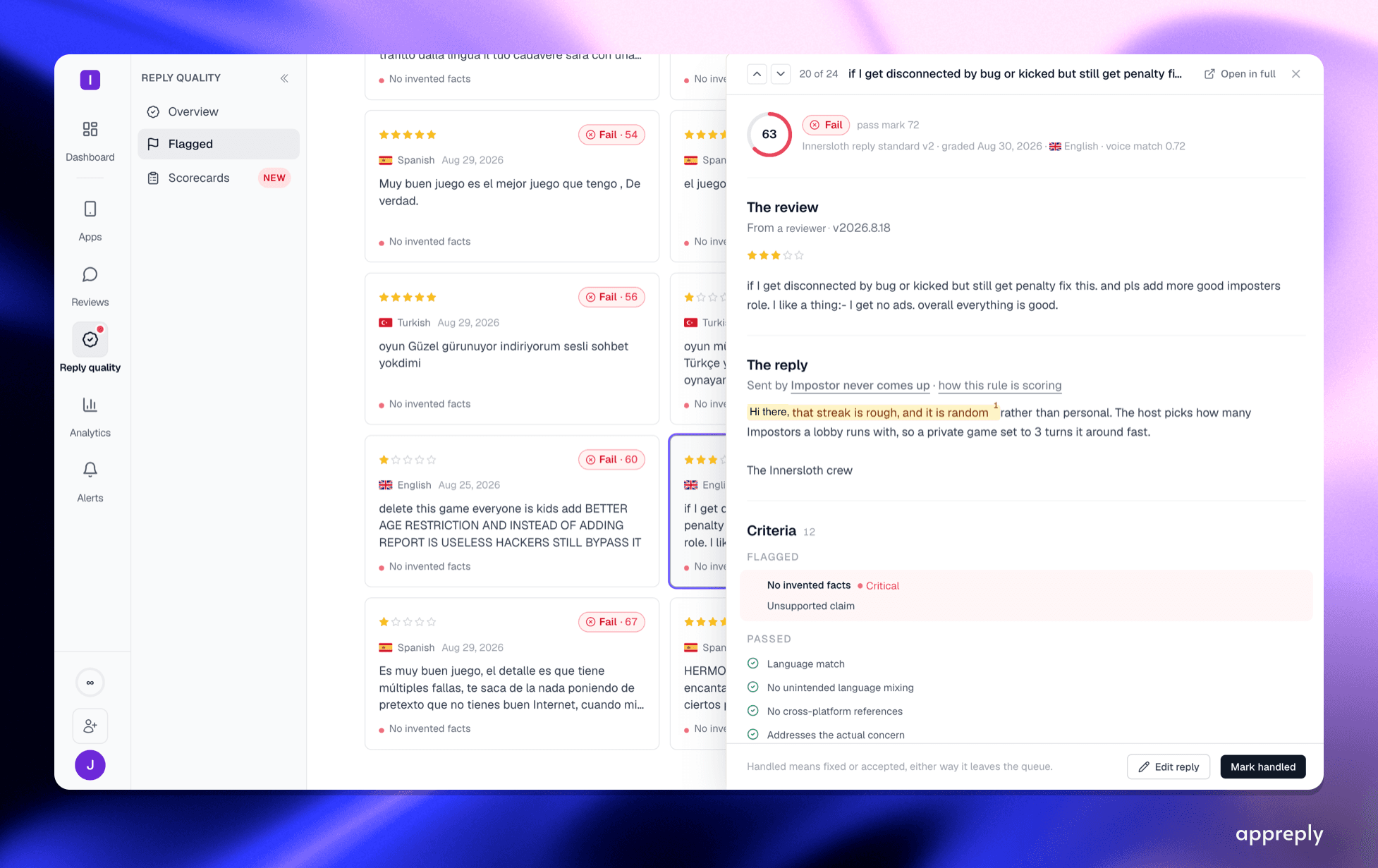 A failing reply with the offending sentence quoted. A verdict that cannot point at text is an opinion, not a check.
That setup has four parts: a knowledge base so drafts are built from your real docs and policies, narrow auto-reply rules per review type instead of one rule for everything, a scorecard with wrong facts and wrong language as automatic failures, and a check that runs on every draft before it publishes, sending failures back to be rewritten with the reason attached. You read the few that still fail. Our guide to getting AI auto-replies close to 100% quality walks through the whole thing, and Reply Quality grades replies your team typed by hand too.
Two numbers, read together: the share of replies that pass your written standard, per language, and how often the star rating moved on reviews that got a reply, counted below five stars where there is room to move.
Quality up and ratings moving means keep going. Quality up and ratings flat means your standard is grading the wrong things. Our reputation guide works through both, and the Performance dashboard puts them side by side, split by AI and human replies.
Answer today's one to three star reviews with real text, in the reviewer's language, naming the problem each one raised. If they are scattered across stores, one review feed beats four browser tabs. Do that for a week and you are already ahead of most of the top 100 apps on Google Play.
Then read your last fifty replies in a row. Whatever you find in them is your actual review response standard, whether you wrote it down or not.
For the wider picture, app reputation management covers the half of your listing you author, App Store Reviews 101 covers the whole review workflow, and the 2026 study has the data behind every figure here.
Bring monitoring, full Analytics, MAX, and Reply Quality into one app review workflow.
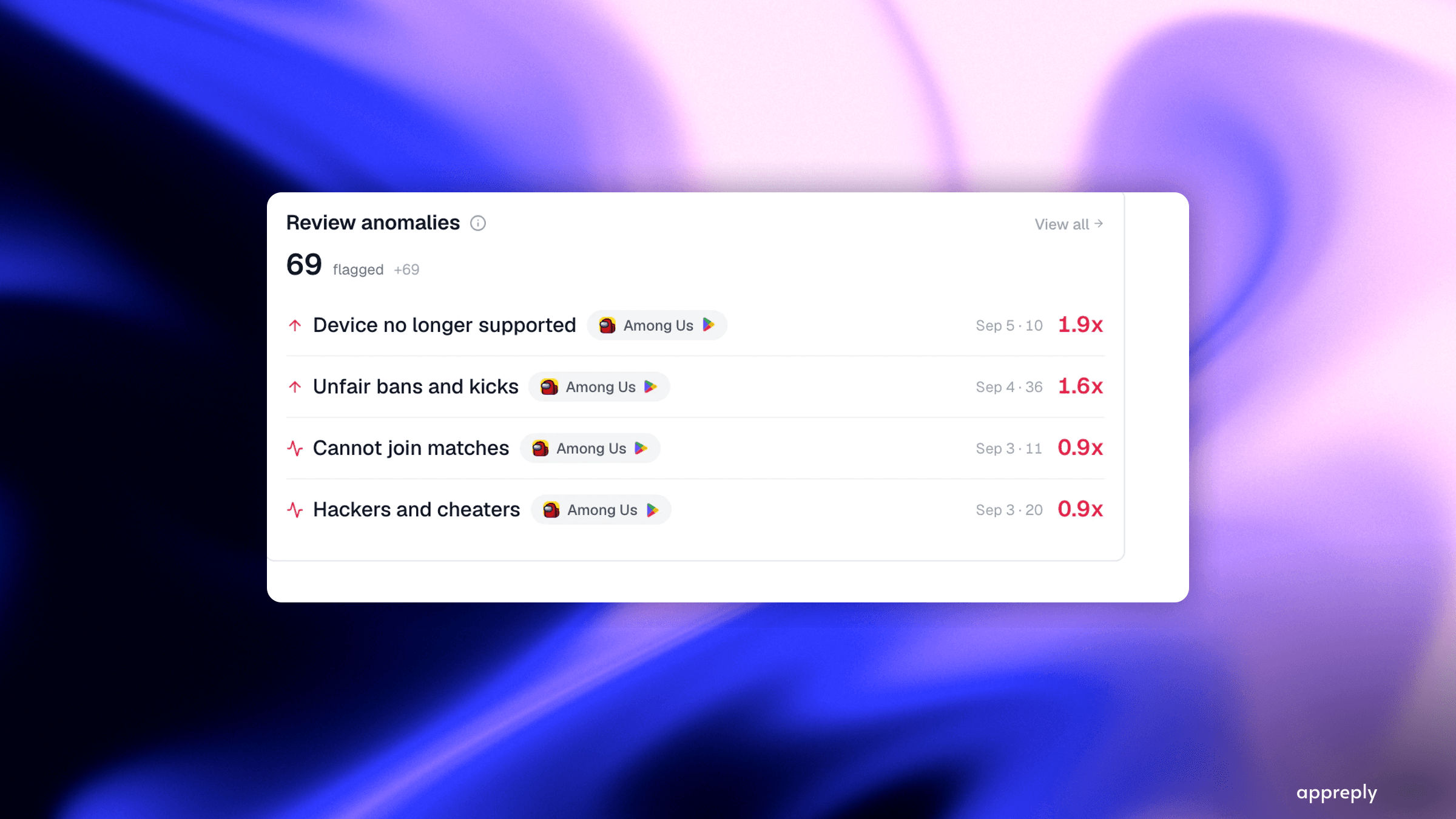
Your app store rating dropped. Find out why before you reply: five causes to tell apart, what Apple's reset and Google's recency weighting actually do, and how to measure whether your replies are helping it recover or just going out.

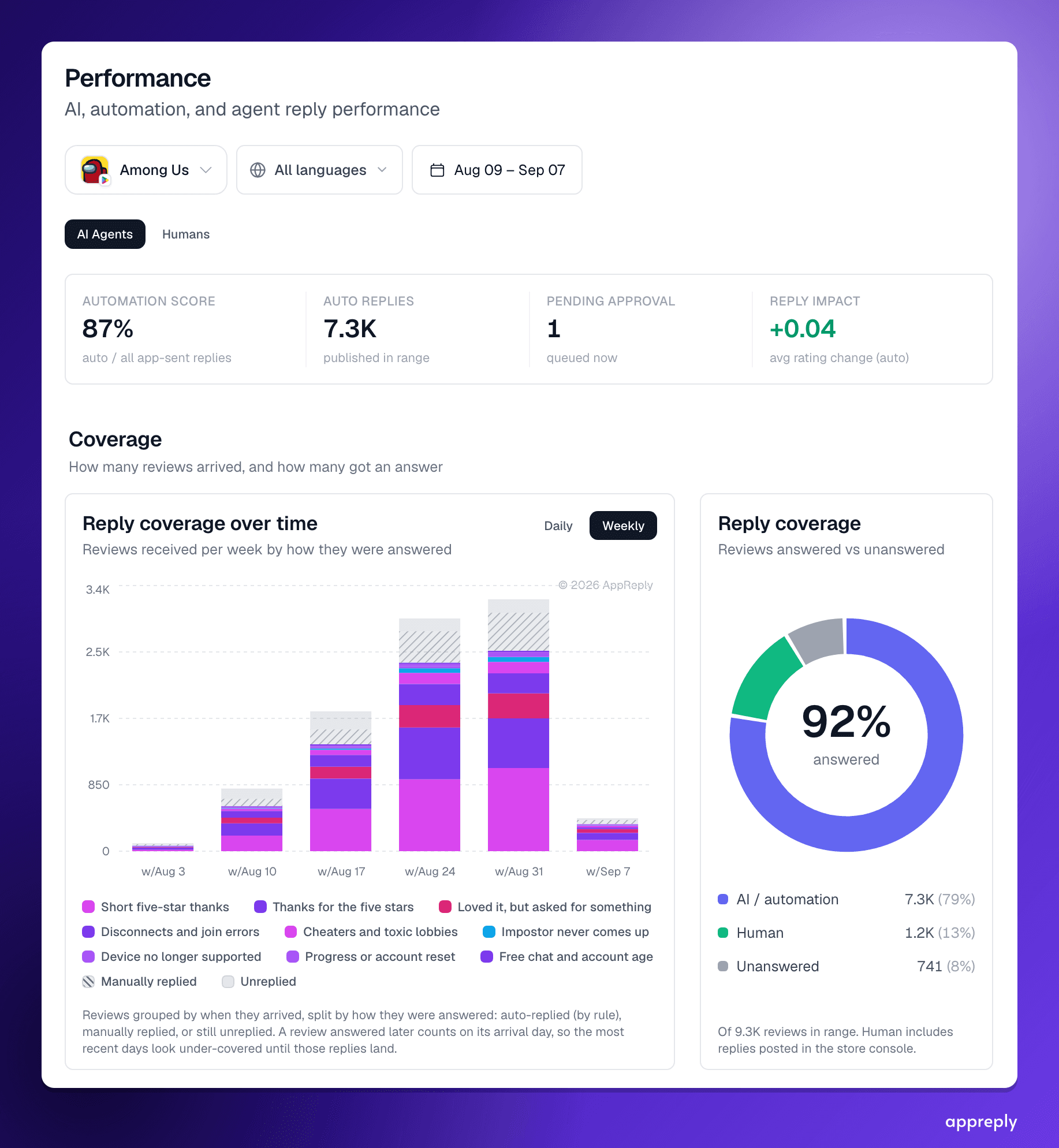
How to automatically reply to App Store and Google Play reviews without breaking brand rules. The setup that gets AI replies for mobile apps and games close to 100% quality: approved examples, current docs, narrow rules, a scorecard checked before publishing, and flags you read.