Loading. Please wait...
A negative review is where a stranger decides whether to trust you. This guide shows real replies to low-star reviews, graded pass or fail with the reason. Then it covers what gets a reviewer to raise their rating, and why your replies now matter to the stores too.
Someone paid for your app, it broke, and they took a minute to tell everyone. Now that review sits under your app for every person who is about to install it. What you write back decides what they see: a company that listens, or one that pastes the same line under every complaint.
This guide is about that reply. It uses real replies from our 2026 study of 100 top Google Play apps, graded pass or fail with the reason, so you can see the difference instead of reading tips about it. For the mechanics of replying in App Store Connect and Play Console, see how to reply to app store reviews.
Answer the exact problem the reviewer raised, say what happens next, and give one way to reach a person. Five steps, one minute:
That is the whole method. The rest of this guide shows what it looks like when replies get it right and wrong, and what happens after you press submit.
Three readers: the reviewer, the next person deciding whether to install, and the store, which summarizes review text on your product page.
The reviewer. On both stores they get a notification when you first reply. That is the moment they decide whether to come back, and whether to change their rating.
The next buyer. Most people who read reviews never write one. They skim the low-star reviews to see if the problem would hit them, and they read your reply to see if anyone is home.
The store. Apple and Google now summarize what reviews say, and your replies appear right under those reviews. Separately, Google's app quality audit reportedly looks at whether replies are templated or personal. More on that below.
A good reply works for all three. A template works for none of them.
Every reply below was written by a developer of a top Google Play app and graded in our study against one question: does it answer what this reviewer actually raised? Reviewer names are removed and apps are described, not named. We paraphrased every review and reply so none can be traced back to an app or a person; what each one says is unchanged. The grading is from a pilot: a model graded each reply, and in an internal check a person disagreed with it on 1 reply in 10.
A two-star review of a mobile game:
Same base-building formula as a dozen other games. I got about ten hours of fun out of it. The sniper missions are the best part.
The reply:
Glad the sniper missions worked for you. We hear that the base building felt familiar and wore off after around ten hours. We'll keep working on the parts that fall short.
Why it passed: it repeats the specific praise and the specific complaint, and it does not argue. It could not be pasted under any other review.
A one-star review of a kids game:
I love this game but watching ads doesn't unlock anything even though I'm online
The reply:
Hi [name], glad you love the game! If watching an ad doesn't unlock items while you're online, update the game and restart your device. If it still happens, email [support address] and we'll look into it.
Why it passed: it names the exact problem (ad unlocks failing while online), gives one fix, and gives one way to reach a person.
A travel app answered nearly every review with this, 1,604 times in 23 days:
Thanks for your kind words. Our mission is to make travel easier for everyone, and reviews like yours show we're on track.
Why it failed: under a complaint it says the opposite of what the reviewer wrote. On a dashboard this app's reply rate looked perfect.
A reply that would pass, under a review that says the booking was cancelled without notice: "Sorry your booking was cancelled without a warning. That should never happen silently. Please send the booking number to our support team, not here, and we will check what went wrong."
A kids game posted this 313 times, mostly under low-star reviews:
Thanks for the feedback. What would it take for you to rate us higher?
Why it failed: it asks for stars before answering anything. The reviewer has already told you what would earn a higher rating. The reply shows nobody read it.
A reply that would pass, under a review about too many ads: "You're right that the ads come too often between levels. We're reducing them in the next update. Thanks for sticking with the game."
Most failing replies were not rude. They guessed.
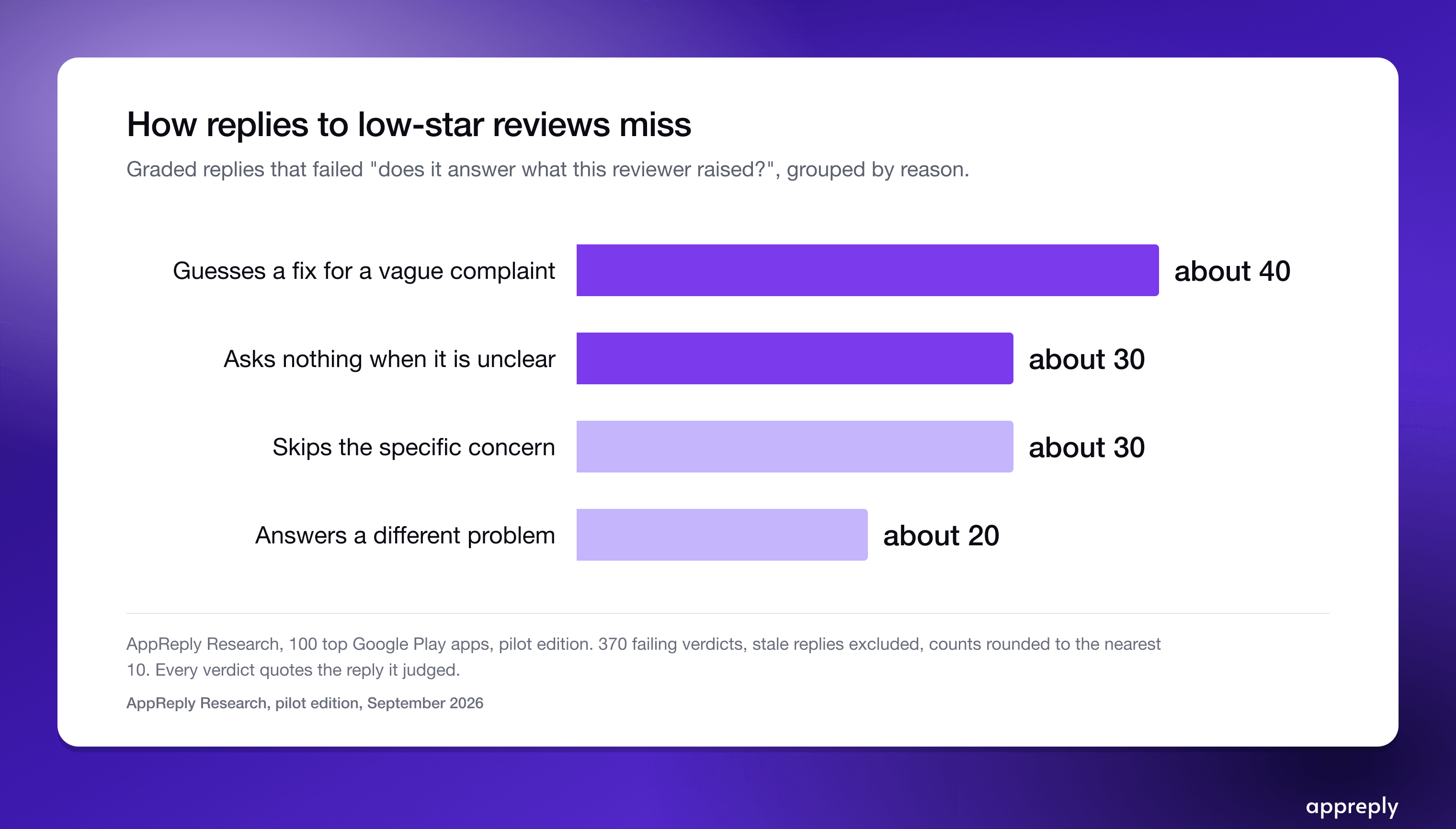 Guessing a fix and asking nothing are the same mistake: answering before understanding.
A reviewer writes "this app is useless now". One reply sends five troubleshooting steps for a problem nobody described. Another says thanks and asks nothing. One question about what went wrong beats both.
The angrier the review, the more often replies missed. Replies to one-star reviews passed 69.5% of the time. Replies to five-star praise passed 95.1%, because thanking a happy person is easy.
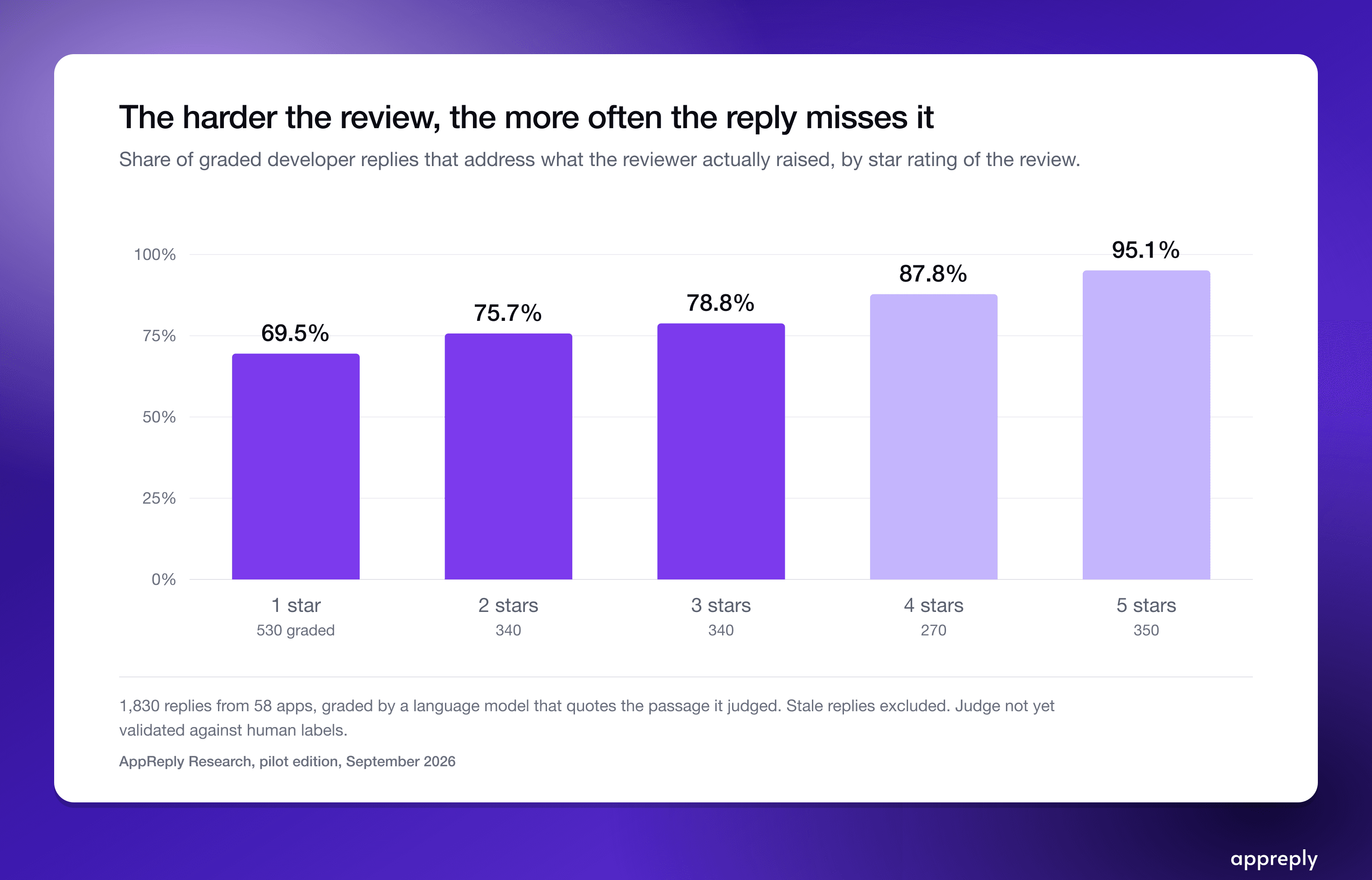 One-star reviews get the replies that miss most often.
Yes. In AppReply data, low-star reviews that got a reply were later raised about 4.6 times as often as those that did not, and a 2018 Google Play study found the same pattern. It is still the exception, so the reply has to be good: a rating change is the clearest proof a reply worked.
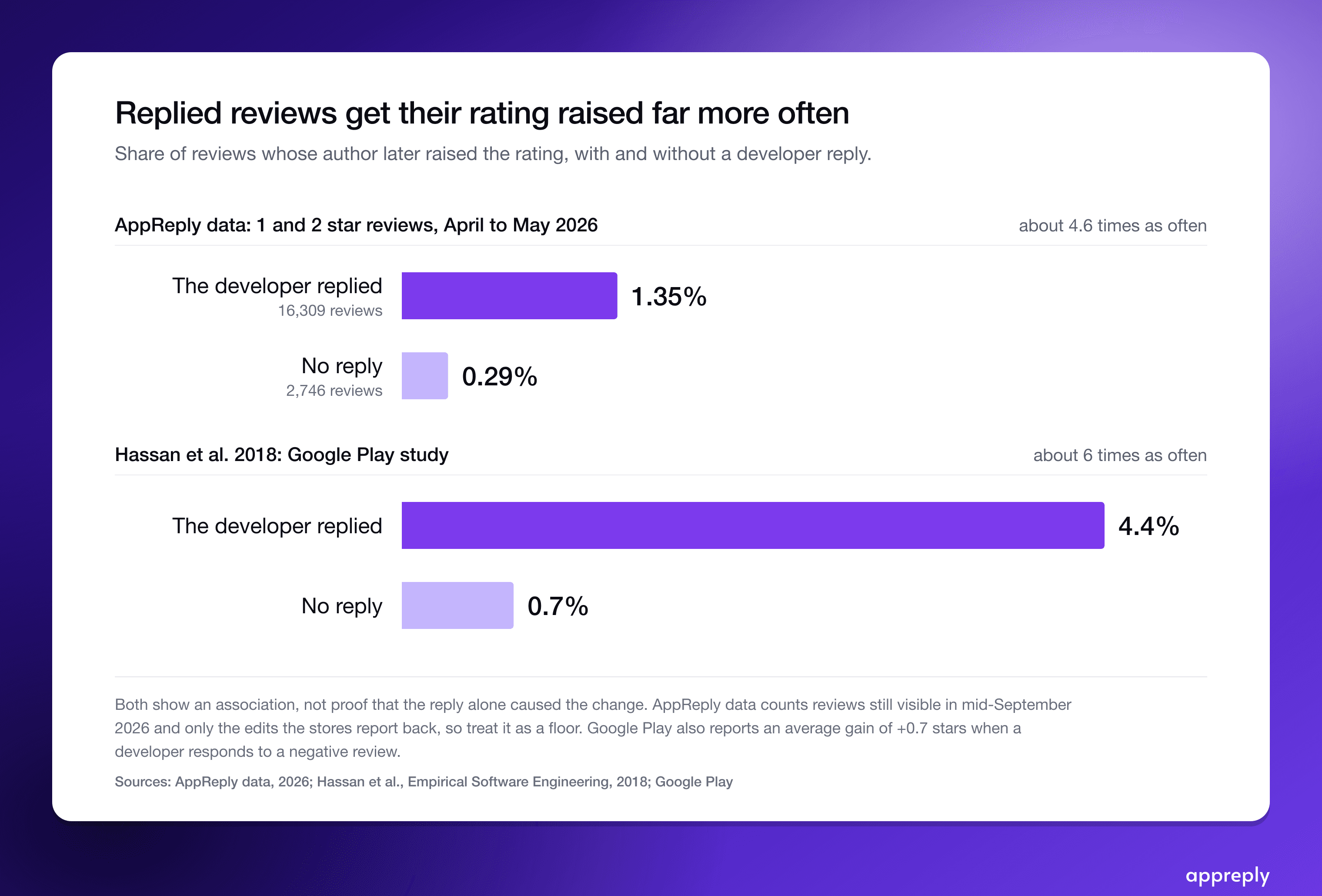 Low-star reviews with a reply were raised about 4.6 times as often in AppReply data and about 6 times as often in a 2018 Google Play study. Both show an association, not proof that the reply alone caused it.
What separates the replies that move a rating:
The first reply does the work. Both stores notify the reviewer when you first reply, and that is when they decide whether to come back. A placeholder like "we're looking into it" spends that moment on nothing.
A fix beats an apology. The studies show that replied reviews get raised more often, not that the words alone do it. Most raised ratings follow a problem that got solved. If a fix is coming, say which release. When it ships, edit your reply to say so, and the next reader sees a problem that got solved.
Specific beats warm. "Crashes when you open the camera on Android 14" tells the reviewer a person read their review. "We value your feedback" tells them nobody did.
Ask only when the review is happy. Some low-star reviews read like five-star ones: warm words, one star. There, a light "if the app works for you now, an updated rating helps other people find it" is fine. Under a complaint it is not. And never offer anything in return: Google Play's policy forbids incentives for ratings, and Apple treats incentivized feedback as manipulation.
Watch for stale replies. About 1 reply in 18 in our study was older than the review above it: the reviewer edited the review after the developer answered. If a review improves, update your reply so it still makes sense.
To see whether your replies move ratings, Play Console shows how many returning users kept, raised or lowered their rating after a reply. We explain how to read that number in our rating recovery guide.
These come from apps that use AppReply. Each is a one-star review that got a reply and was later raised by the reviewer. Apps are described by category only. Every review and reply is paraphrased, and translated where needed, so none can be traced back to an app or a person. Seven are from Google Play and one from the App Store, written in six languages.
A network utility app:
The map used to show the markers and now it shows nothing. Clearing the cache didn't help.
The reply:
Sorry about this. The map should show them, so this isn't expected. Email us your area and what you see on the map, and we'll look into it.
The reviewer later rewrote the review: thanks for the fix, the map works again, great app. 1 star to 5 stars.
Why it passed: it says plainly that this is a bug, not the user's fault, and asks for the two details the team needs.
A wellness app:
Doesn't work on Android. There's no login screen, just a blank page.
The reply:
Sorry the app opens to a blank screen for you. Please update to the latest version and open it again. If the login screen still doesn't show, email our support team with your phone model and Android version.
The updated review: it had some trouble starting, but it's all fine now. 1 star to 5 stars.
Why it passed: it repeats the exact symptom, gives the fix that already exists, and asks for two details only if that fails.
A subscription app:
Hi, I want to cancel and I can't find where to do it in the app.
The reply:
Thanks for asking. A subscription bought through Google Play is managed in Google Play, not in the app. Open Google Play, go to your subscriptions, pick our app and cancel there. Deleting the app does not cancel it.
The reviewer added a thank-you. 1 star to 4 stars.
Why it passed: it answers the question in the reply instead of sending the person to support, and it warns about the trap: deleting the app does not cancel. Helping someone leave still earned three stars back.
A mobile game:
I liked the game even with all the ads, but my progress has reset to the start twice now. Fix it or I'm deleting it.
The reply:
We're really sorry. That's not the experience we want you to have. Please contact support through the in-game chat so we can check your account. We've shared your review with the team.
The updated review: a fun game, and the developers answer fast and fix problems. 1 star to 5 stars.
Why it passed, just: it points to a private channel and asks for nothing sensitive in public. It does not say whether the progress can be restored, which would have made it stronger. The support team did the rest.
A phone app:
Two weeks ago you said you'd fix the call history that comes back after I delete it. Nothing has changed!
The reply:
Good news: the call history issue is fixed in the latest version. Update the app, and if anything still looks wrong, email us and we'll help.
The updated review: the call history is fixed, thank you. 1 star to 5 stars.
Why it passed: the anger was about a broken promise. The reply closes it by pointing to the release with the fix.
A drawing app on the App Store:
I have to pay for everything, even to ask the AI for something. The few free things are poor.
The reply:
Sorry it wasn't what you expected. We get that paying for content is frustrating. You can still use a lot without paying, like a new free lesson every day and many free images to draw.
The updated review: right after posting, they found the free parts and made some great drawings. 1 star to 5 stars.
Why it passed: it does not argue about the price. It points to exactly what is free, which the reviewer had missed.
A security app:
Don't install this. I got hacked after downloading it, so I deleted this virus.
The reply:
We understand you're worried after being hacked. This app protects Android phones from malware. It is not malware itself. If you notice anything suspicious, contact our support team and our specialists will check it with you.
The reviewer later found the real cause, another app showing fake pop-ups, and raised the rating. 1 star to 5 stars.
Why it passed: it corrects the fact once, calmly, without blaming the reviewer, and offers help. This is the "reviewer is wrong" case done right.
A VPN app:
It keeps saying the server is unavailable and to try again later. I tried for hours. I'll look for another VPN.
The reply:
That message can appear when your network restricts VPN connections. Turn the VPN off to check your connection. Then try the other connection protocols in settings one by one, and a different region. If nothing works, contact our support team.
The updated review: after reinstalling, it connects, though some settings have to be changed by hand, so it may not suit everyone. 1 star to 5 stars.
Why it passed: it explains the exact error message and gives the steps in order. The point about setup still stands. A reply cannot fix that part.
| The review said | What the reply did | Rating |
|---|---|---|
| A feature broke after an update | Confirmed the bug, asked for two details | 1 to 5 |
| The login screen is blank | Named the symptom, gave the fix that exists | 1 to 5 |
| I can't find how to cancel | Answered in the reply, warned that deleting the app doesn't cancel | 1 to 4 |
| My game progress reset | Sent them to a private support channel | 1 to 5 |
| You promised a fix and didn't deliver | Pointed to the release with the fix | 1 to 5 |
| Everything costs money | Listed what is free | 1 to 5 |
| This app is a virus | Corrected the fact once, offered help | 1 to 5 |
| The server is unavailable | Explained the error, gave steps in order | 1 to 5 |
Every reply answers that reviewer's exact problem. In most of them the problem was then fixed, or turned out to be a misunderstanding the reply cleared up. The rating moved when the problem did. Six of the eight were drafted by AI in AppReply under the app team's own rules. Two were written by a person. Specific does not have to mean handwritten.
Apple and Google summarize review text on your product page, and your replies sit directly under those reviews. Google has published no rule on replies, but one reported audit grades whether they are templated or personal. For years a reply was customer service. It is becoming part of how the stores present your app.
The stores read review text. Apple and Google both summarize reviews on the product page. Those summaries draw on what reviewers say, and your replies appear right under the reviews they summarize.
Google's audit reportedly grades reply quality. In September 2026, Den Markov published a breakdown of Google's app quality audit. One score, in his words, looks at "reply rate and the quality of replies: templated or personalised". His case study had a 100% reply rate, all templates, and still scored Medium on user reviews. This is one reported audit, not a published Google policy, so treat it as a direction rather than a rule. We cover it in the 2026 reply study.
Templates are everywhere. 42.3% of the 37,110 replies in our study were word-for-word copies of another reply from the same app. The real share of canned replies is higher, because a template that adds the reviewer's name counted as unique.
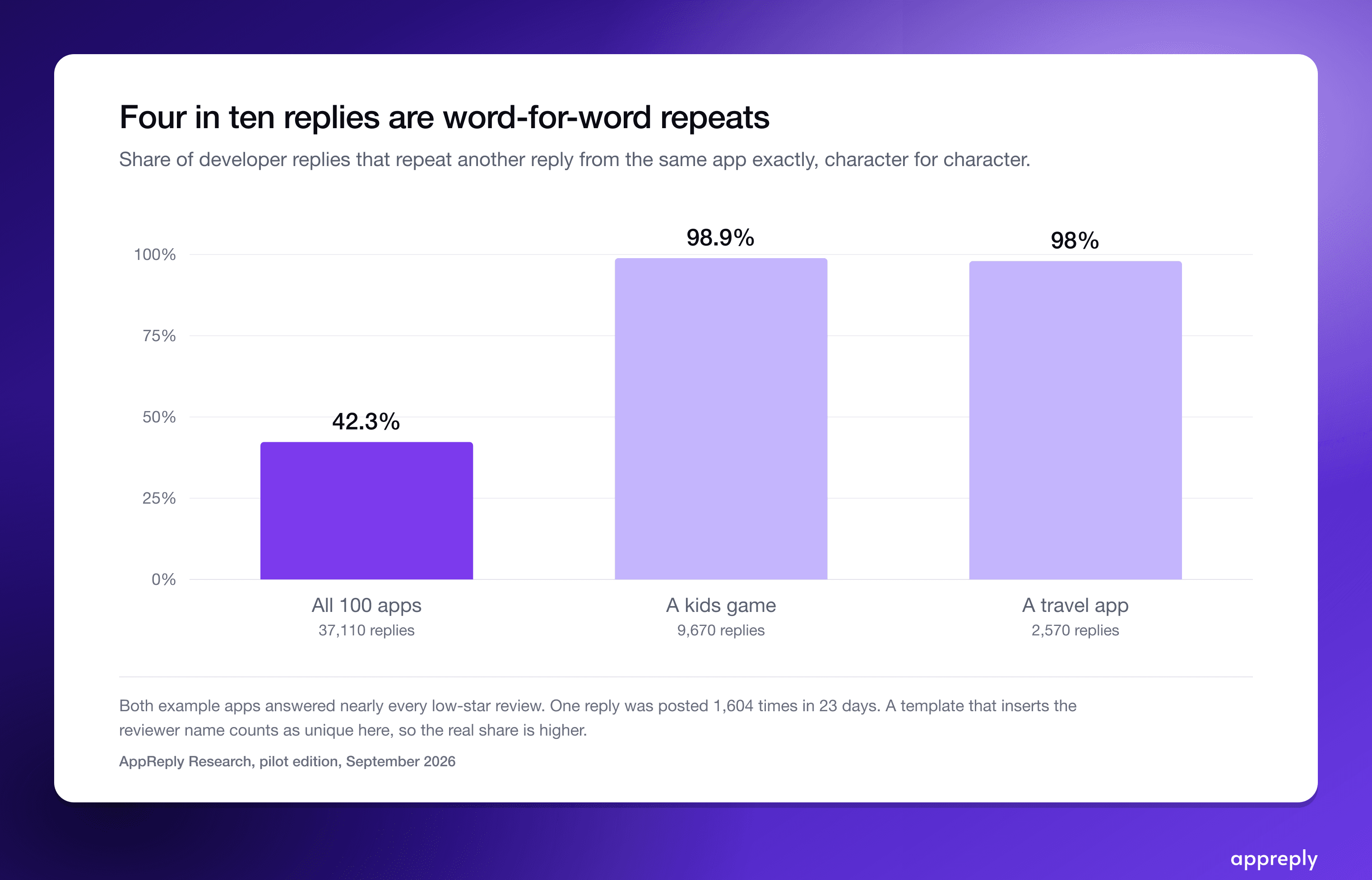 Some apps repeat almost every reply.
What this does to installs. Your rating and the reviews people see first decide how many people who land on your page install. A specific reply under a bad review can turn a warning into proof that problems get fixed. That is the part of your store page you control directly. For the wider picture, see app reputation management.
For the move that passes on each kind of complaint (crashes, refunds, lost accounts, ads, missing features, one star with no text), see replies by review type.
Pick your last 20 replies to one to three star reviews and check each one:
If more than a few fail, the problem is rarely the person writing them. It is usually volume, no clear standard, or nobody checking.
That last part is what Reply Quality does in AppReply. You write your standard once as a scorecard. When a scorecard is on, AI drafts are checked against it before they publish, and published replies are graded after, with the failing sentence quoted. If you answer reviews by hand, the same four questions work on paper. If you answer at volume, our guide to auto-reply quality covers how to keep AI replies at that standard.
AppReply drafts personalized, platform-aware responses for every review, so your team reviews and publishes instead of writing from scratch.
See how it worksA negative review is not the end of the conversation. For the person reading it before they install, your reply is the second half of the review.
The graded replies come from the AppReply 2026 study of 100 top Google Play apps, pilot edition (full method). The raised-rating examples and figures come from apps that use AppReply, measured in September 2026. Every review and reply is paraphrased, with reviewer names and apps removed.
How we counted raised ratings: we compare each review's rating when the reply was sent with its rating in mid-September 2026. The 4.6x figure compares one and two star reviews written in April and May 2026, with and without a reply. Over a longer window, October 2025 to mid-September 2026, 624 of 56,791 replied one and two star reviews were later raised (1.1%), 436 of them to four or five stars, and 163 went down. Treat these rates as a floor: we only see the edits the stores report back.
Bring monitoring, full Analytics, MAX, and Reply Quality into one app review workflow.
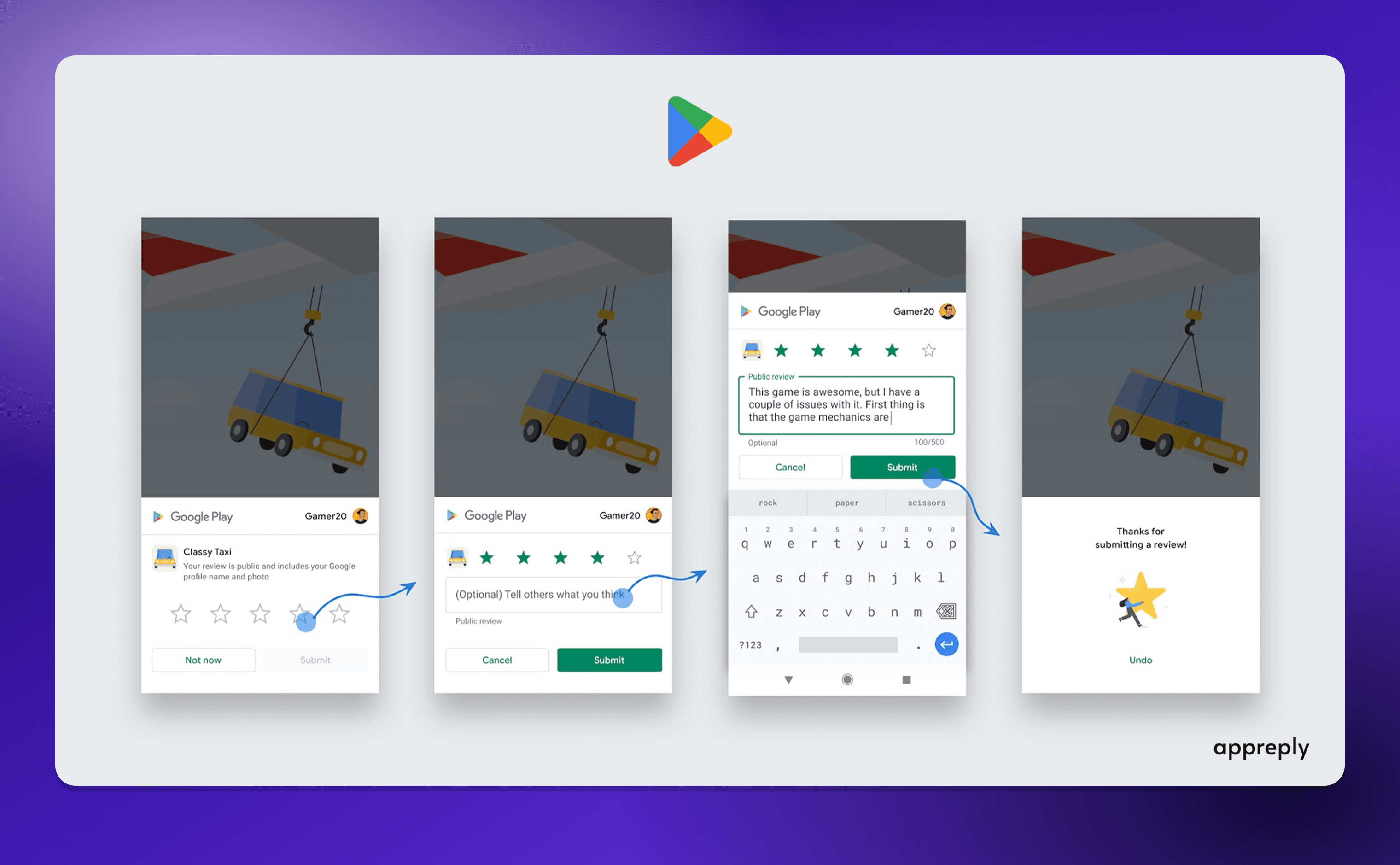
When to show the native review prompt on iOS (requestReview, SKStoreReviewController) and Android (In-App Review API), with code, limits and gating rules.

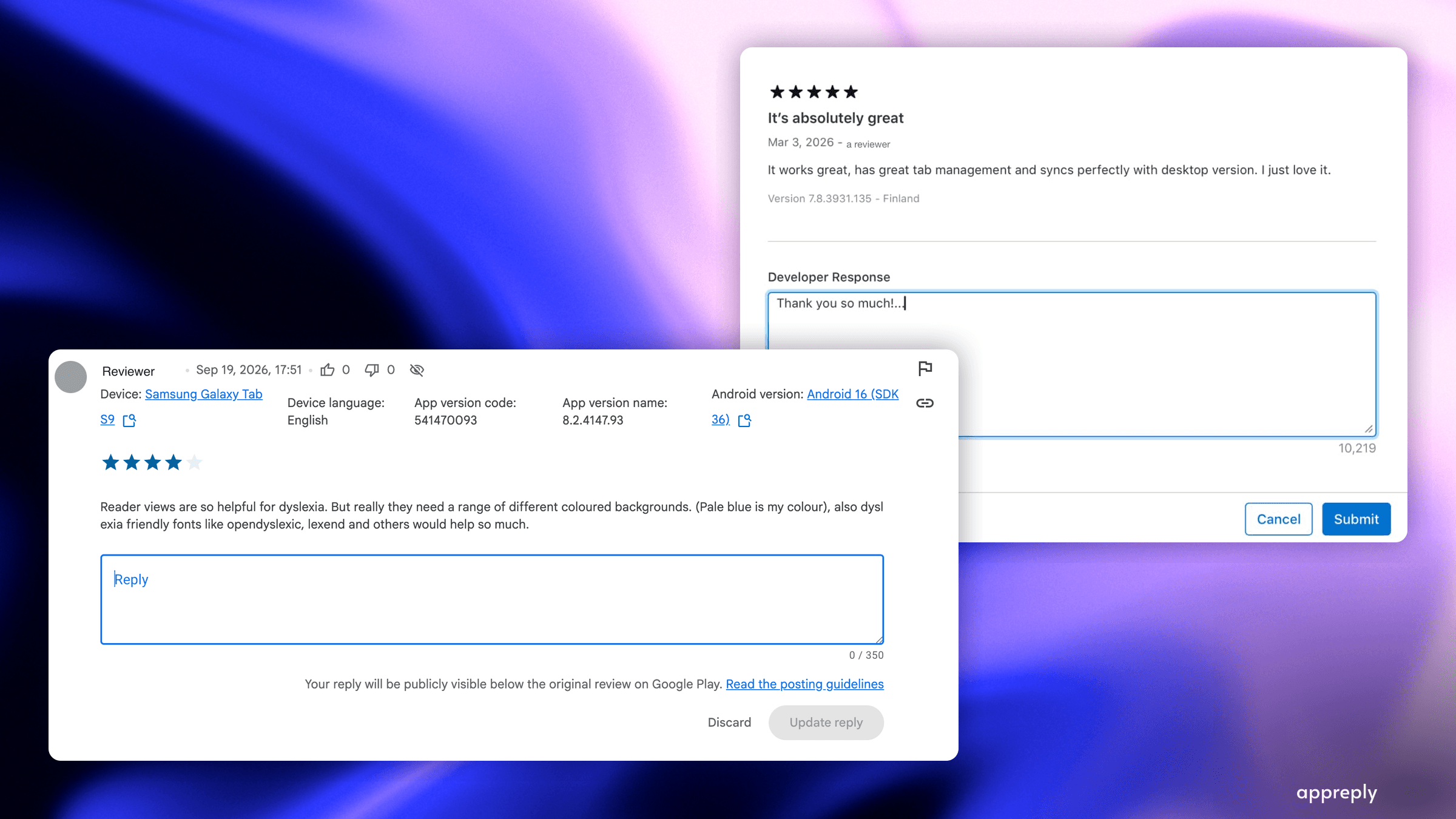
How to reply to app store reviews on iOS and Google Play in 2026: what to write, the steps in both consoles, real replies by review type, and what 100 top apps actually send back.