
9 best ASO tools in 2026: which are worth paying for
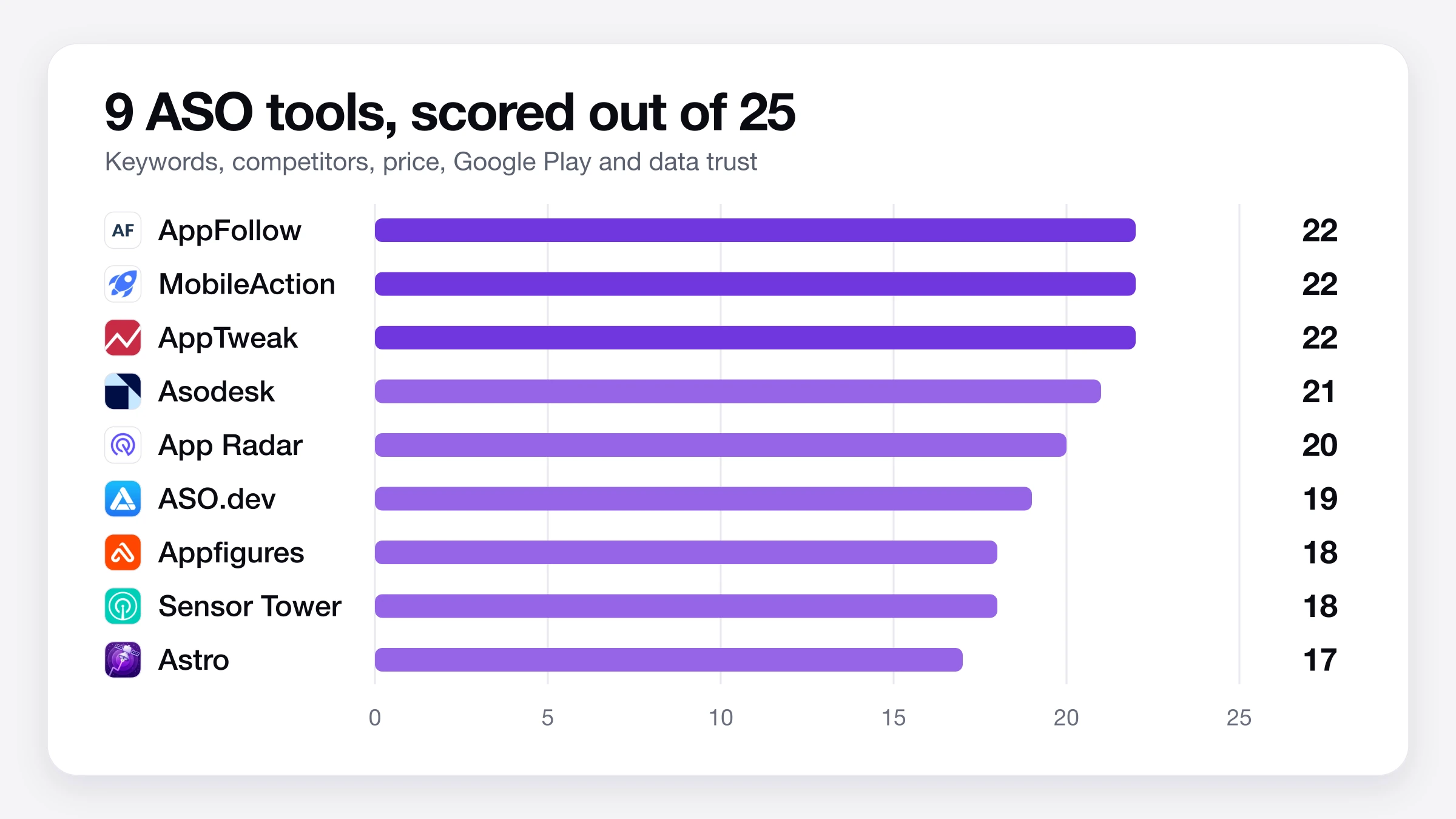
Astro starts at $9 a month billed yearly for iOS keyword tracking. We scored 9 ASO tools on keyword research, competitor research, price, Google Play support and data they can trust. AppFollow, MobileAction and AppTweak tie at 22 of 25. AppFollow ranks first because it has a free plan and a $19 a month plan that covers the job; MobileAction has the cheapest paid entry for both stores; AppTweak has the deepest research but costs the most of the three. Asodesk would have tied too, but we took points off because it sells incentivized installs. Apple's and Google's free consoles are not keyword tools, so we treat them as the free baseline, not as contestants.
Key takeaways
- Prices start at $9 a month. Astro costs $108 billed yearly for iOS-only keyword tracking. For both stores, MobileAction Lite costs $12.50 a month and AppFollow's ASO plan costs $19 a month, both billed yearly. AppFollow also has a free plan.
- Three tools tie at the top, for different reasons. AppFollow, MobileAction and AppTweak each score 22 of 25. AppFollow wins the tie on price: a free plan and a $19 a month plan that covers the job.
- AppTweak has the deepest keyword research and the clearest data notes, and the highest entry price of the three, $79 a month billed yearly, with 1 seat on every self-serve plan.
- ASO.dev is an option for iOS teams tracking many keywords. Indie includes unlimited App Store keywords and competitor rank research for $29 a month billed yearly per seat. Google Play support covers listing and release workflows.
- "500 keywords" means a different amount on each pricing page. AppTweak and AppFollow count a keyword once per store and country; Appfigures counts it once across apps and countries.
- Asodesk would have tied for first. It sells incentivized installs to raise search rank, which Apple's guidelines prohibit, so we cut its trust score.
Where we stand
ASO tools are mostly sold as databases: more keywords, more countries, more dashboards. Read what buyers actually ask, and a different picture shows up. They want to find good keywords, see what competitors do, cover Google Play, trust the numbers, and not pay "$100+/month" to do it, as one r/AppStoreOptimization thread put it.
So we took a side:
- Pay for keyword data sized to your job. A solo developer and a ten-person growth team should not be buying the same plan.
- Distrust numbers a vendor will not explain. Apple publishes search popularity. Almost everything else, including all Google Play popularity, is modeled. That is fine, as long as the tool tells you.
- Do not buy rank. We took points off a vendor that sells incentivized installs next to its keyword tool.
- Test your store page in Apple's and Google's free consoles. They are not keyword tools, so we did not score them against keyword tools. We tell you what they do in the free baseline.
What people actually ask for
We picked the five tests from what people type and ask, not from vendor feature lists. Google's search suggestions for ASO tools, read on November 21, 2026, include:
- Keywords: "aso keyword research tools", "aso keyword tool free", "aso keyword ranking"
- Price: "best free aso tools", "aso tool free", "cheap aso tools", "free aso tools reddit"
- Google Play: "best aso tools for google play store", "aso tools for android", "astro aso tool for android"
- Competitors: "aso spy tool", "sensor tower alternatives", "apptweak free alternative"
- Trust: "is sensor tower accurate"
Threads in r/AppStoreOptimization say the same thing in plain words. An indie developer asked for "keyword tracking, search volume data, and basic competitor insights" without the "$100+/month" tools (r/AppBusiness). Another asked which tool is best "for ASO and competitor analysis" and to "rank their authenticity" (r/AppStoreOptimization). A third called a big tool's competitiveness score "a black box" (r/iOSProgramming).
The five tests
| Test | What earns 5 points | What earns 1 point |
|---|---|---|
| 1. Keyword research and rank tracking | Popularity and difficulty, keyword suggestions, daily or faster rank tracking, on the entry plan | Rank tracking only, or none |
| 2. Competitor research | What competitors rank for, their listing and creative changes, and download estimates | Little or none |
| 3. Price for the starter job | Under $20 a month billed yearly | Over $250 a month, or no public price |
| 4. Google Play | Google Play keyword research and rank tracking, with its modeled data explained | App Store keyword research only |
| 5. Data you can trust | Sources, refresh times and estimates documented, and nothing that buys rank | A black box |
The Google Play test gives 2 points for listing and release tools alone. Keyword research and rank tracking earn the higher scores.
The starter job is what the threads above describe: one app on both stores, keyword research, rank tracking for at least 100 keywords, and competitor keywords. For tools with iOS-only keyword research, we price the iOS work and score Google Play separately. Price points: under $20 a month billed yearly is 5, $20 to $50 is 4, $50 to $100 is 3, $100 to $250 is 2, anything higher or unpublished is 1. Teams that need more people and a year of history should read what a two-person team pays.
The scorecard
| Tool | Keywords | Competitors | Price | Google Play | Trust | Total |
|---|---|---|---|---|---|---|
| 1. AppFollow | 4 | 4 | 5 | 5 | 4 | 22 |
| 2. MobileAction | 4 | 4 | 5 | 5 | 4 | 22 |
| 3. AppTweak | 5 | 4 | 3 | 5 | 5 | 22 |
| 4. Asodesk | 5 | 4 | 4 | 5 | 3 | 21 |
| 5. App Radar | 4 | 4 | 3 | 5 | 4 | 20 |
| 6. ASO.dev | 5 | 4 | 4 | 2 | 4 | 19 |
| 7. Appfigures | 4 | 3 | 2 | 5 | 4 | 18 |
| 8. Sensor Tower | 4 | 5 | 1 | 5 | 3 | 18 |
| 9. Astro | 4 | 3 | 5 | 1 | 4 | 17 |
 2. MobileAction
 3. AppTweak
 4. Asodesk
 5. App Radar
 6. ASO.dev
 7. Appfigures
 8. Sensor Tower
 9. Astro
Ties are broken on price, because price came up more than anything else in what people asked. Scores come from public pages read November 21 and 22, 2026. The evidence for each one is below.
Our call on each, in one line:
- AppFollow. Best for most people: free plan, $19 entry, unlimited users.
- MobileAction. Cheapest paid entry with competitor estimates.
- AppTweak. Deepest research, if ASO is someone's job.
- Asodesk. Strong research, docked for selling installs.
- App Radar. Best if you edit listings in many languages.
- ASO.dev. Unlimited App Store keywords and competitor tracking, priced per seat.
- Appfigures. Best if you track many countries.
- Sensor Tower. Best competitor and market data, no public price.
- Astro. Best for solo iOS developers on a Mac.
The tools, in rank order
1. AppFollow: 22 of 25
Our call: the best starting point for most people. It covers the starter job for $19 a month billed yearly, has a free plan, and every plan has unlimited users. The catch is history: 30 days on the ASO plan.
 Good: AppFollow's keyword table puts popularity, difficulty and your daily rank change in one row, with an Android tab next to iPhone and iPad. Image: AppFollow.
 Good: the update timeline marks the day each app changed its metadata or visuals, so you can line up a competitor's listing change with a rank move. Image: AppFollow.
- Keywords (4). AI keyword suggestions, keyword tracking, popularity and difficulty, and search downloads on the ASO plan. Tracked ranks refresh daily around European midnight, and a live ranking check runs every two hours.
- Competitors (4). 30 competitors on the ASO plan, an update timeline of rivals' titles, icons, screenshots and videos by country, and competitor search traffic, which AppFollow labels as estimates from public data.
- Price (5). Free is $0. ASO is $19 a month billed yearly or $29 monthly, for 500 keywords and 2 sources (an iOS app and a Google Play app are one source each). Essential is $129 billed yearly ($179 monthly) with 365 days of history and a 10-day trial that needs no card. Pricing
- Google Play (5). Both stores on every plan. Android popularity comes from AppFollow's own model with 15-plus inputs, and connecting Play Console gives real downloads by keyword.
- Trust (4). For supported iOS markets, popularity is Apple Search Ads popularity, unchanged. Points off because its pages contradict each other on refresh times (weekly in one article, every two weeks in another) and on the Free plan (500 keywords and unlimited users in the plan table, 1,000 keywords and 5 members in the FAQ).
- Also good to know: AppFollow's review tools go deeper than most ASO tools, and its MCP connector is on every plan. Each keyword counts once per store and country, so 500 terms on both stores in 5 countries is 5,000 slots. Keyword counting
A user on Capterra, December 3, 2024: "It was difficult to connect our Android app, and some of the filtering mechanisms aren't obvious how to use." (Third-party review, not a vendor claim.)
2. MobileAction: 22 of 25
Our call: the cheapest paid way to get keyword research plus a look at competitors' downloads. Fine for one person; for a team, the price jumps to $199.
 Good: keyword ideas come from named sources, including Google Play Suggestions, one of the few places a tool shows Google Play data it did not model itself. Image: MobileAction.
 Good: the metadata optimizer calls its forecast a "Rank Impact Estimation", so a prediction is labeled as one. Image: MobileAction.
- Keywords (4). Lite includes keyword research tools, AI keyword suggestions, volume and difficulty scores, real-time keyword search and a limited ranked-keywords report. Ranks update daily. Pro adds organic downloads per keyword and brand vs generic keywords.
- Competitors (4). 3 competitors per app on Lite, metadata analysis, and download and revenue estimates labeled as estimates. Basic adds competitive metadata and an update timeline; Pro adds creative monitoring of up to five apps side by side.
- Price (5). Lite is $12.50 a month billed yearly ($15 monthly) for 100 keywords, 5 apps, 1 seat and 3 months of history. Basic is $59 billed yearly ($69 monthly) for 500 keywords. The trial asks for billing details, and reusing a card can skip it. Pricing
- Google Play (5). Both stores. Google Play volume is modeled from Google's web traffic, and MobileAction says so.
- Trust (4). Volume is a relative 5 to 100 score, with Apple's data checked daily from Apple's popularity report. The difficulty formula and current accuracy figures for estimates are not listed.
- Watch out for: the API and MCP need a separate plan. "Keywords are tracked per app and per country", per its help center, and the pricing page does not say how that counts against your quota. Keyword tracking rules
A user on G2, February 10, 2025: "it takes awhile to figure out all the bells and whistles." (Third-party review, not a vendor claim.)
3. AppTweak: 22 of 25
Our call: the deepest keyword research here and the most honest notes on where its numbers come from. Worth the price if ASO is someone's actual job. Overkill, and one seat, if it is not.
 Good: Keyword Explorer shows volume, reach and difficulty for one keyword, with an App Store and Google Play toggle and the live search results beside them. Image: AppTweak.
 Good: AppTweak shows its volume estimate next to the value without it, so you can see what the tool adds for small keywords, where Apple's own score stops at 5. Image: AppTweak.
- Keywords (5). Essential includes 12+ keyword research tools, chance and difficulty scores, volume history for both stores, volume estimates and unlimited live keyword searches. Grow adds organic installs per keyword, long-tail and trending keywords, and a metadata simulator. Tracked keywords refresh daily.
- Competitors (4). 5 competitors per app on Essential, competitor metadata and creatives, tracking of competitors' A/B tests, and download and revenue estimates. Analysis of every keyword a competitor ranks for is on Enterprise.
- Price (3). Essential is $79 a month billed yearly ($99 monthly) for 5 apps, 500 keywords, 1 seat and 6 months of history. The 7-day trial needs billing details. Pricing
- Google Play (5). Volume history for Google Play, labeled as modeled, plus a Play Console connection for your real Google Play keyword data.
- Trust (5). AppTweak separates Apple's raw 5 to 100 popularity score from its own estimate, explains that download estimates come from chart ranks trained on data from connected apps, and even says its August volume model change was not backfilled, so charts can jump without your performance changing.
- Watch out for: every self-serve plan has 1 seat; more seats mean Enterprise. Replying to reviews is a separate product, from $83 a month billed yearly.
4. Asodesk: 21 of 25
Our call: on research alone it would tie for first. We took two points off trust because Asodesk also sells incentivized installs to move search rank, and we do not think a vendor should profit from both your keyword advice and buying your rank.
 Good and bad on one screen: estimated installs are labeled as estimates, and every keyword row also has a Boost button that sells installs to move that keyword's rank. Image: Asodesk's Keyword Boost page.
 Bad: a Keyword Boost campaign prices 5,016 incentivized installs at $0.89 each, $4,464 for one day, to push a keyword up. Image: Asodesk's Keyword Boost page.
- Keywords (5). Pro includes a keyword explorer, keyword table, keyword manager and daily impressions estimates; Guru adds auto-suggestions, keyword translations and full keyword tools. Ranks update at least every 24 hours.
- Competitors (4). 200 competitor apps on Pro, competitor analytics and side-by-side competitor creatives. Estimated installs per keyword for competitors is on Power.
- Price (4). Pro is $47 a month billed yearly ($59 monthly) for 700 keywords, 2 apps and 2 teammates. The lower $41 welcome price applies once, for the first 3 months. Pricing
- Google Play (5). Both stores, plus Huawei AppGallery and Samsung Galaxy Store as add-ons on its custom plan.
- Trust (3). The data notes are among the best here: the inputs behind impressions, difficulty and estimated installs are listed, and Apple's Search Ads popularity is kept separate. The deduction is for Keyword Boost, which sells incentivized installs to raise App Store search rank, with per-install prices for iOS and Android. Apple's App Review Guideline 5.6.3 says manipulating "charts, search, reviews, or referrals to your app erodes customer trust and is not permitted", and Apple says it may expel developers who inflate rankings through "paid, incentivized, filtered, or fake feedback" or third-party services. Keyword Boost · Apple's guidelines
A user on Capterra, February 9, 2024: "Traffic and search volume calculation for Google Play can be very inaccurate." (Third-party review, not a vendor claim.)
5. App Radar: 20 of 25
Our call: a good fit if you want keyword research and listing editing for both stores in the same tool. Pick it if you update metadata often, in many languages. App Radar is now part of SplitMetrics.
 Good: the listing editor uses Google Play's own fields and limits, 80 characters for the short description and 4,000 for the long one, and shows keyword density for the full description. Image: App Radar help center.
 Good: the keyword tracker shows rank, 30-day change, volume, difficulty and relevancy for each keyword. Image: App Radar.
- Keywords (4). Keyword research and tracking from Essentials, with real-time live search. Apple popularity comes straight from Apple.
- Competitors (4). 25 competitors on Essentials to track keyword ranks, creatives and reviews, localized competitor screenshots and videos, and a timeline that logs competitors' Google Play A/B tests. App download estimates start on Growth.
- Price (3). Essentials is $690 a year ($57.50 a month) or $69 monthly, for 2 app slots (one app on both stores uses both), 500 keywords and 1 seat. The trial needs a card. Pricing
- Google Play (5). Both stores, including editing the Google Play title and descriptions. Google Play popularity is estimated from ranking and indexing patterns, and App Radar says so.
- Trust (4). Sources are explained, but the difficulty formula and exact rank refresh schedule are not listed.
- Also good to know: the listing editor exports to your consoles; for iOS you still submit a new version in App Store Connect. Review replies are included, 50 a month on Essentials. Store listing editor
6. ASO.dev: 19 of 25
Our call: a good fit for iOS teams that want unlimited keywords and competitor ranks on Mac, Windows or Linux. Indie keeps 30 days of daily ranks. Astro costs less for solo developers focused on their own iOS ranks. If you need keyword analytics for both stores, compare App Radar for listing editing or MobileAction for a lower entry price.
 Good: Keywords: Competitors puts your App Store rank next to each competitor's rank, with popularity and difficulty in the same row. The example uses mock data. Image: ASO.dev.
- Keywords (5). Indie includes unlimited tracked App Store keywords, Apple Ads popularity, difficulty scores, and ideas from App Store autocomplete and Guided Search. The tracking list updates every four hours. Daily rank history goes back 30 days on Indie and 60 days on Pro and Marketing.
- Competitors (4). Indie shows the keywords competitors rank for by country, plus screenshots, custom product pages and A/B tests. Competitor app cards show download and revenue figures. Pro adds a changelog for rivals' listing text, icons and screenshots. Marketing adds bulk creative research.
- Price (4). Indie costs $29 a month per seat billed yearly ($348 per year) or $39 monthly, before VAT. Console starts at $15 a month billed yearly for listing and release work. Paid plans list a three-day trial. A free ASO analytics plan is not listed. Pricing and plan limits
- Google Play (2). ASO.dev can edit Google Play listings, upload screenshots and manage releases. Keyword research and rank tracking cover the App Store.
- Trust (4). ASO.dev names Apple Ads as the source of search popularity and bases difficulty on popularity and how many apps use the keyword. Competitor app cards present download and revenue figures. The docs do not explain how these are calculated or label them as estimates. Keyword data and refresh
7. Appfigures: 18 of 25
Our call: the fairest keyword counting in this list and good reporting on your own apps' downloads and revenue. Research and competitor estimates sit behind its pricier plans.
 Good: each score carries an "updated" date, and the top 10 apps' downloads and revenue are labeled as estimates. Image: Appfigures.
- Keywords (4). Rank tracking starts on Monitor (100 keywords, daily). Keyword suggestions and research are on Optimize, where keyword performance updates hourly. Keyword performance
- Competitors (3). Compare organic keywords across up to 8 apps, one store and country at a time, with a 24-hour delay. Competitor download and revenue estimates and creative comparison start on Boost, $599.99 a month.
- Price (2). The starter job needs research, so Optimize: $119.99 a month billed yearly or $149.99 monthly, for 500 keywords. Monitor is $35.99 billed yearly for tracking alone. The Optimize trial needs no card. Pricing
- Google Play (5). Both stores, plus keyword field and description helpers for both on every plan, including Free.
- Trust (4). Popularity is an indexed score using Apple Search Ads and other signals; download estimates are trained against real data from opted-in apps. A separate Google Play source breakdown is not listed.
- Also good to know: a keyword counts once across apps and countries, so tracking in many countries does not multiply your bill. Up to 5 users are included, and API, CLI and MCP access come with every account.
A verified user on G2, May 16, 2026: "Keyword performance tracker was robust for what we needed," but "Everything is gated." (Third-party review, not a vendor claim.)
8. Sensor Tower: 18 of 25
Our call: the best competitor and market data here, and the answer to "is there a Sensor Tower alternative" is yes, for keyword work. Buy Sensor Tower when you need market-wide downloads, revenue and ad data.
 Good: Sensor Tower shows which competitors bid on a keyword and their share of voice over time. The catch is the price, which you only get after a demo. Image: Sensor Tower.
- Competitors (5). Downloads, revenue, active users, retention, ratings and ad creatives for any app, plus an update timeline of competitors' icons, screenshots, titles and subtitles. App Performance Insights
- Keywords (4). Keyword discovery, competitor gaps, keyword lists and rank tracking.
- Price (1). No public price: "We customize pricing plans for each customer." Pricing
- Google Play (5). Both stores.
- Trust (3). Sensor Tower names its sources (a panel, first-party data and public sources) and labels downloads and revenue as estimates, but how its keyword traffic score is calculated is not listed.
- Context: Sensor Tower bought data.ai, formerly App Annie, in March 2024, and AppMagic in May 2026 as its offer for smaller companies.
A user on G2, November 2, 2026: "Estimates can be off for smaller or niche apps." (Third-party review, not a vendor claim.)
9. Astro: 17 of 25
Our call: the best value in ASO if you only ship iOS apps and work alone on a Mac. The "astro aso tool for android" searches have no answer: it is App Store only.
 Good: popularity, difficulty, your rank and the competing apps for each keyword in one table. It only fills in while the Mac app is running. Image: Astro.
- Keywords (4). Popularity from Apple Ads, Astro's own difficulty score, keyword suggestions and unlimited tracking. Ranks update every 24 hours, but only "when the app is running", per Astro's docs, so closing it leaves gaps. Keyword data
- Competitors (3). Extracts keywords from competitors' titles and subtitles. No download estimates or creative tracking.
- Price (5). $108 a year ($9 a month) for unlimited apps and keywords. A free trial covers 1 app and 10 keywords, and there is a 14-day refund window. Astro
- Google Play (1). Not covered. Mac only, macOS 14 or later.
- Trust (4). Sources and refresh are documented. Difficulty is a proprietary estimate.
What "500 keywords" means on each pricing page
Price came up more than anything in what people asked, and this is where pricing pages mislead without lying. Take 500 terms, tracked on both stores in 5 countries:
| Tool | How a keyword is counted, per the vendor | Slots used | Cheapest plan that fits |
|---|---|---|---|
| Appfigures | Once across apps and countries | 500 | Optimize, $119.99 a month billed yearly |
| Astro | Unlimited | Unlimited (iOS only) | $108 a year |
| ASO.dev | Unlimited tracked App Store keywords across 60 countries | No quota (iOS only) | Indie, $29 a month billed yearly per seat |
| AppFollow | "Each keyword for the store and country is counted as 1 keyword" | 5,000 | Team, $425 a month billed yearly |
| AppTweak | Once only when store, country and language match | 5,000 | Enterprise, price on request |
| Asodesk | Not listed | Up to 5,000 | Up to Power, $343 a month billed yearly |
| MobileAction | "Keywords are tracked per app and per country"; quota counting not listed | Up to 5,000 | Up to Enterprise, price on request |
| App Radar | Pooled across apps and countries; repeat counting not listed | Up to 5,000 | Possibly above Scale's 3,000 |
Before you buy, ask the vendor in writing: "If I track the same keyword on both stores in five countries, how many keywords does that use?"
What a two-person team pays
The starter job assumes one person. Add a second person and a year of history, and the order changes:
| Tool | Cheapest plan with 2+ people and 12 months | Price, billed yearly |
|---|---|---|
| Asodesk | Pro (2 teammates; history depth not listed) | $47 a month |
| Appfigures | Optimize (5 users; history depth not listed) | $119.99 a month |
| AppFollow | Essential (unlimited users, 365 days) | $129 a month |
| App Radar | Growth (2 seats, 12 months) | $140.83 a month |
| MobileAction | Pro (3 seats, 12 months) | $199 a month |
| AppTweak | Enterprise (custom seats) | Price on request |
| Sensor Tower | Custom | Price on request |
| ASO.dev | Pro has trends back to September 2024, with daily ranks limited to 60 days. Indie keeps 30 days of ranks. | $138 a month for two Pro seats or $58 for two Indie seats |
The free baseline every tool sits on
App Store Connect and Google Play Console do not track keyword ranks, show competitors or estimate search volume, so they would score 1 on our first two tests. But every paid tool's own guides send you back to them for one job: testing your store page. Use them first.
- App Store Connect. Product page optimization tests up to three versions of your icon, screenshots and previews against the original, for up to 90 days. Custom product pages give you up to 70 extra versions, and you can assign keywords so one shows in search results for those searches. One catch: the "App Store search" source in App Analytics includes search ads, so it is not organic search. Product page optimization · Custom product pages
- Google Play Console. Store listing experiments test up to two variants against your listing, including description text in localized tests, and up to 50 custom store listings can target countries or search keywords. The store performance report shows search terms that brought people to your listing, with low-volume terms grouped into "Other", and Play Search there is mostly searches for your app's name. Experiments · Store performance
- SplitMetrics Optimize tests simulated store pages on paid traffic, up to eight variants, which helps before launch when there is no store traffic. Custom pricing; check any winner with Apple's or Google's own tests. Optimize
 Good, and free: App Store Connect reports impressions, conversion rate, improvement and confidence for each version of your page. Paid ASO tools can only estimate this. Image: Apple.
One thing no keyword tool fixes: your rating
Your rating sits next to your icon in search results, and Apple says your summary rating is "displayed on your product page and in search results" (Apple). Google says "Responding to a negative review can increase that rating by an average of +0.7" (Google Play Console). In our study of 100 top Google Play apps on US charts, 8 in 9 low-star reviews got no reply. Ratings did not make our five tests, because buyers do not shop ASO tools for them. They are still worth your time: start with in-app review prompts and replying to app store reviews.
How we scored
- Tests from intent, not features. The five tests come from Google search suggestions for ASO tool queries and r/AppStoreOptimization threads, read on November 21, 2026.
- Sources for scores. Each vendor's public pricing, product and help pages, read November 21 and 22, 2026. No accounts, trials or demos, so anything behind a login was not scored.
- Equal weights, ties broken on price. Five tests, 1 to 5 points each, 25 in total.
- Trust includes conduct. A vendor that sells incentivized installs loses two points on trust, whatever its data notes say.
- "Not listed" means what it says. It is not the same as "it can't". Where a vendor's own pages disagree, we say so.
- User quotes from G2 and Capterra are labeled as third-party, with dates. They are color, not evidence for a score.
- Product images are the vendors' own, from their public websites and help centers, credited in each caption. They show demo data, not our accounts.
- No affiliate links, no paid placements.
If a fact about your product is wrong, tell us through the contact page and we will correct it.
Frequently asked questions
What is the best ASO tool in 2026?
What is the best free ASO tool?
What is the best ASO tool for Google Play?
What is the cheapest ASO tool for indie developers?
What is a good Sensor Tower alternative?
How accurate is ASO tool data?
How were the tools scored?
See every review. Know what changed. Reply with confidence.
Bring monitoring, full Analytics, MAX, and Reply Quality into one app review workflow.
More blog posts to read
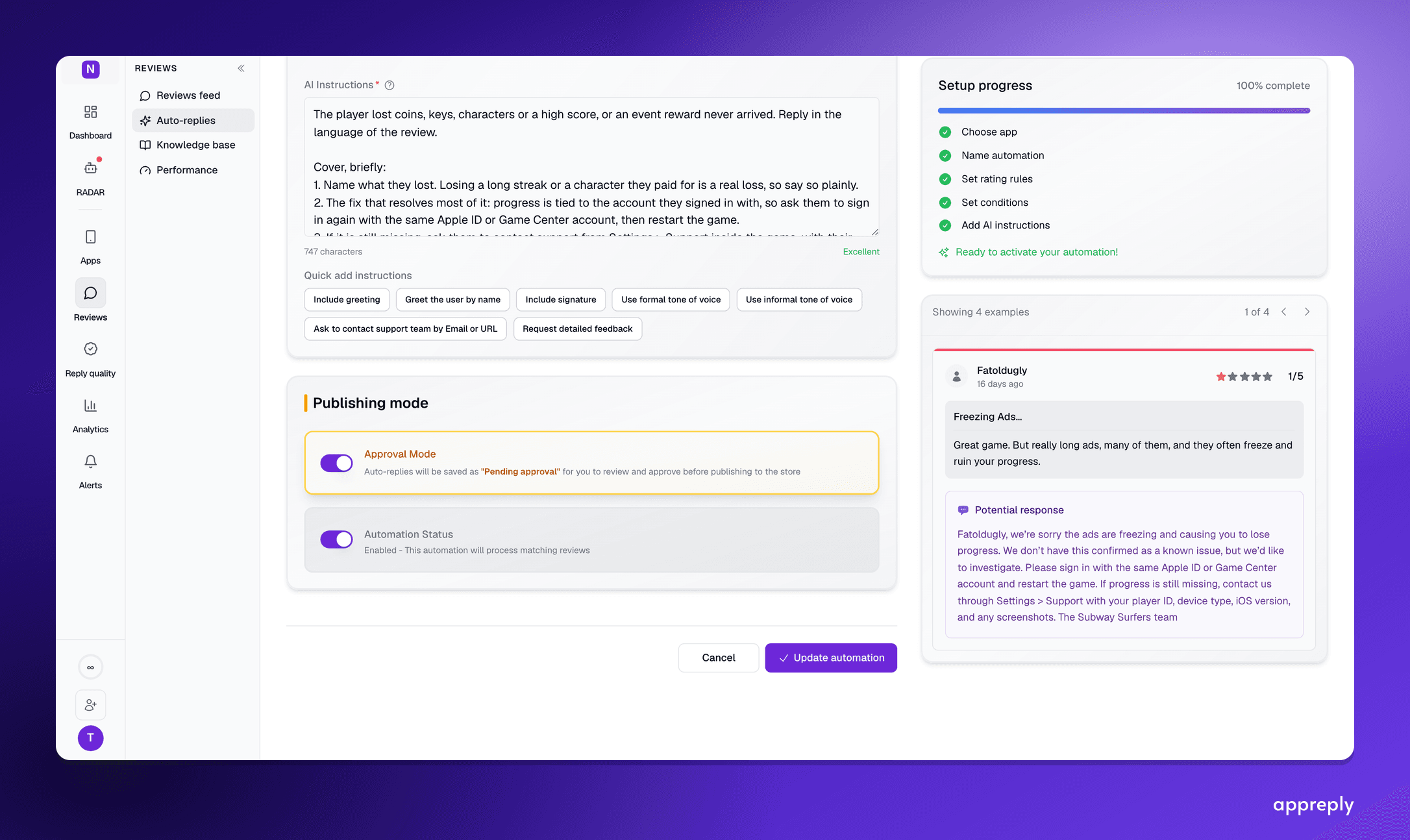
AI replies to App Store reviews: what an agent can publish on iOS, and what waits for you
How AI replies to App Store reviews work on iOS: Apple's rules, which replies to publish automatically and which should wait for approval, and what to ask an AI agent about your iOS reviews.

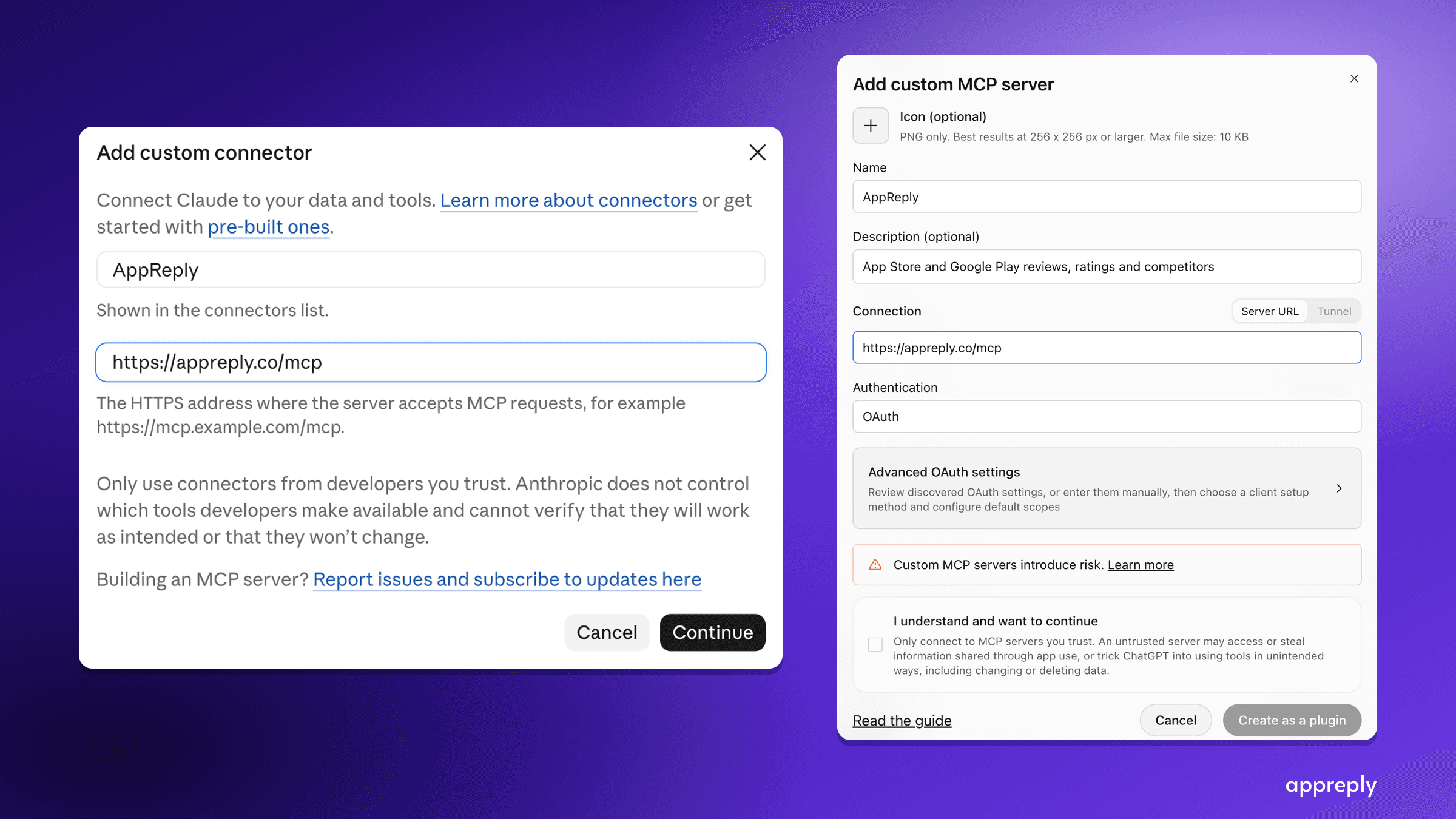
App Store and Google Play MCP server: analyze app reviews in Claude, ChatGPT or Cursor
Connect Claude, ChatGPT or Cursor to AppReply's MCP server at appreply.co/mcp. Ask about your app reviews, insights and knowledge base, or research any app on the App Store and Google Play. Setup, the 16 tools, limits and first questions.